


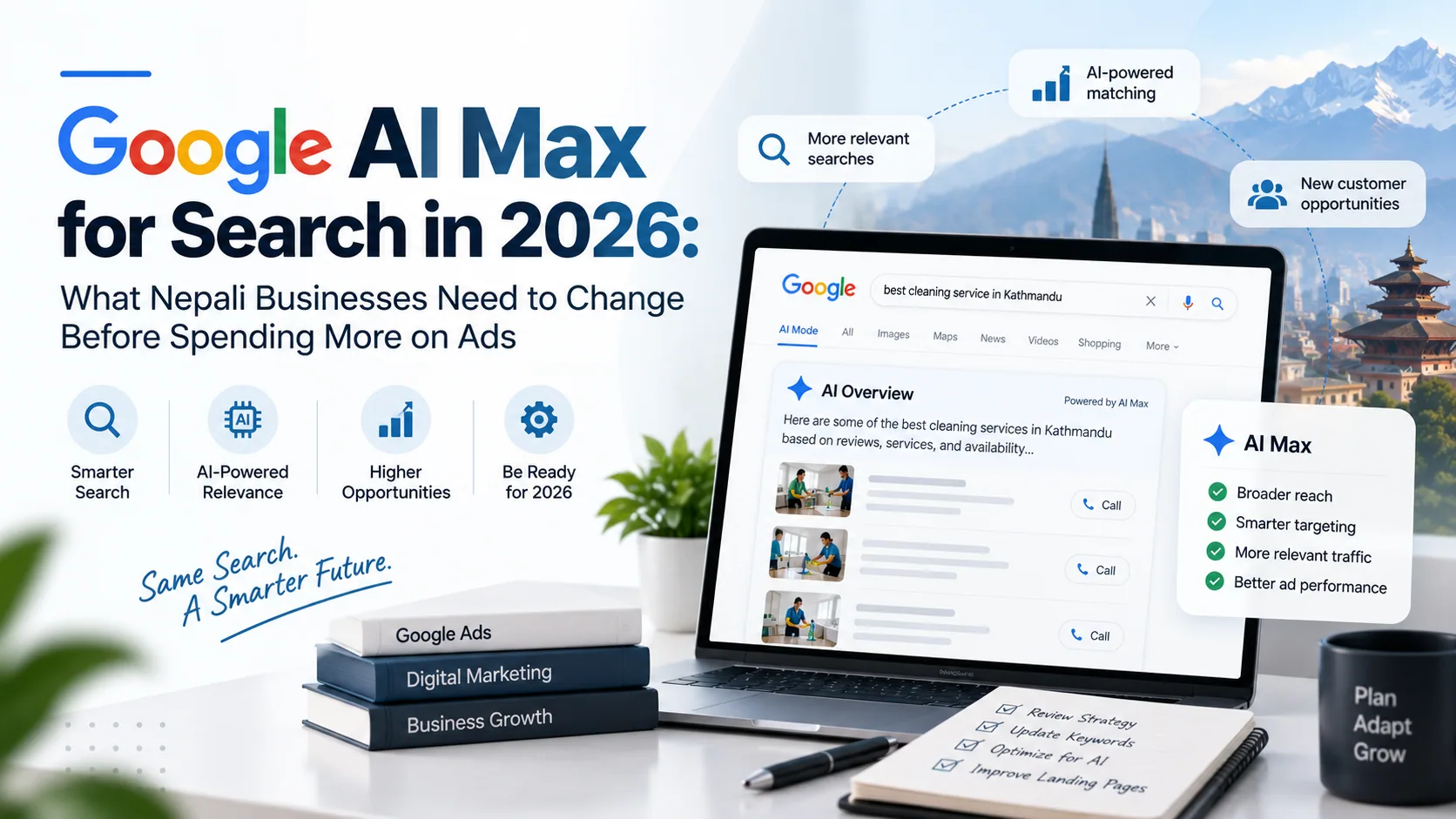
Google Ads is changing again, but this update is more significant than a new reporting column or campaign setting. AI Max for Search gives Google more freedom to decide which searches are relevant, how an advertisement should be adapted and which page on a website should receive the visitor.
For Nepali businesses, AI Max could uncover search opportunities that traditional keyword lists miss. It could also spend money on weak enquiries if conversion tracking, location settings, website content and campaign controls are not ready.
This distinction matters because many Google Ads accounts in Nepal are still measured through clicks, calls, form submissions and WhatsApp actions without consistently checking which enquiries became qualified prospects or paying customers.
AI Max does not remove the need for campaign strategy. It changes where that strategy is applied. Advertisers may spend less time manually expanding keyword lists, but they need to pay closer attention to conversion data, landing-page quality, exclusions, brand controls, geographic targeting and sales feedback.
Google has also started moving selected legacy Search campaign features into AI Max. Campaigns using Automatically Created Assets and campaign-level broad match are scheduled for automatic upgrades beginning in September 2026. The Dynamic Search Ads transition has been extended, with automatic upgrades now expected to begin in February 2027.
This guide explains what Google AI Max for Search does, what changes after activation, where businesses can lose control and how Nepali advertisers can test it without handing over their budget blindly.
What Does Google AI Max Mean for Nepali Businesses?
Google AI Max for Search uses artificial intelligence to find additional relevant searches, adapt advertising messages and direct users to suitable pages on an advertiser’s website.
It works inside a Search campaign rather than operating as an entirely separate campaign type. Advertisers can activate AI Max features while continuing to use keywords, negative keywords, audience signals and other campaign controls.
The opportunity is broader and more flexible search coverage. A business may reach a potential customer whose search does not exactly match the keywords already listed in the campaign but still indicates a relevant commercial need.
The risk is that AI Max learns from the information it receives. If the campaign treats low-value calls, accidental button clicks or unrelated form submissions as successful conversions, the system may search for more people likely to complete those same low-value actions.
Nepali businesses should therefore prepare their measurement, landing pages and campaign controls before expanding automation. The most useful test is not whether AI Max increases traffic. It is whether it produces more qualified enquiries, appointments, quotations and customers at an acceptable cost.
Key Takeaways
- AI Max is a collection of AI-powered features within Google Search campaigns.
- Its main capabilities include search-term matching, text customisation and final URL expansion.
- AI Max can help advertisers reach relevant searches that are not covered by their existing keyword lists.
- It does not eliminate keywords, negative keywords or campaign management.
- Automatically Created Assets and campaign-level broad match are moving into AI Max from September 2026.
- The automatic transition of Dynamic Search Ads is scheduled to begin in February 2027.
- Google reports average performance improvements across participating advertisers, but those results are not guaranteed for individual businesses.
- The quality of conversion data directly affects what an automated campaign learns to pursue.
- Counting every call or message as a successful lead can create misleading campaign performance.
- Final URL expansion makes website structure and individual service pages more important.
- Nepali campaigns need careful location controls because place names and service areas can overlap.
- English, Nepali and Romanised search behaviour can create opportunities that rigid keyword lists overlook.
- Brand and non-brand traffic should be separated when their commercial roles are different.
- A campaign should be judged by qualified leads and sales outcomes, not only platform-reported conversions.
- AI Max should be tested against a clear baseline rather than activated across every campaign simultaneously.
- Human review remains necessary for generated text, search themes, landing-page selection and lead quality.
- Businesses with weak tracking should improve measurement before increasing automation.
- No agency, advertising platform or AI system can responsibly guarantee leads, conversions or revenue.
What Is Google AI Max for Search and How Does It Work?
AI Max for Search adds a layer of artificial intelligence to an existing Search campaign so Google can interpret more queries, adapt advertisements and choose relevant website pages using the information available in the account.
Traditional Search campaign management has depended heavily on selecting keywords, writing advertisements and sending visitors to predetermined landing pages. That model still exists, but search behaviour is becoming more conversational, detailed and unpredictable.
A customer may no longer search only for “digital marketing agency Nepal.” The person may search for “agency that can fix expensive Google Ads with low-quality leads in Kathmandu” or “who can manage Search campaigns for an Australian cleaning company from Nepal.”
An advertiser cannot manually predict every useful variation. AI Max is designed to interpret this wider intent while using the advertiser’s keywords, advertisements, website content and campaign settings as inputs.
The three central AI Max capabilities
Search-Term Matching
Search-term matching can identify relevant searches beyond the advertiser’s current keyword list by examining intent and other available signals.
Text Customisation
Text customisation may adapt advertising messages using existing advertisements, landing pages and campaign information to improve relevance.
Final URL Expansion
Final URL expansion can direct a user to another relevant page on the advertiser’s website when that page appears better suited to the search.
AI Max is not a completely separate campaign type
Businesses do not need to rebuild every Search campaign from the beginning simply to access AI Max. The features sit inside eligible Search campaigns and can work alongside the existing account structure.
This matters for businesses with years of advertising data. Historical campaign information, existing advertisements and established landing pages can continue to contribute to the account. However, previous performance does not automatically mean the account is ready for greater automation.
AI Max does not mean Google Ads runs itself
The campaign still needs commercial direction. Someone must decide which services are profitable, which locations can be served, which enquiries are valuable, which claims are permitted and how much the business can afford to pay for a customer.
AI can make execution faster, but it cannot independently determine whether an enquiry is suitable for the business. A campaign may generate more calls while the sales team reports that the callers are outside the service area, seeking employment, requesting unavailable services or expecting prices the company cannot offer.
AI Max can expand how a Search campaign finds demand. It cannot decide what demand is commercially valuable unless the business supplies reliable information.
What is changing in September 2026?
Google has announced that eligible Search campaigns using Automatically Created Assets and campaign-level broad match will begin moving into AI Max from September 2026.
The transition does not apply identically to every legacy setting. Campaigns using Automatically Created Assets are expected to enter AI Max with search-term matching and text customisation enabled. Campaigns using campaign-level broad match are expected to transition with search-term matching enabled.
Google originally planned to begin moving Dynamic Search Ads at the same time. An update published in June 2026 extended the Dynamic Search Ads sunset and automatic transition to February 2027.
Businesses should check their accounts rather than assuming nothing will change. Account notifications, campaign eligibility and current settings may determine which upgrades are applied.
Why Does AI Max Matter for Google Ads in Nepal?
AI Max is particularly relevant in Nepal because local searches often combine several languages, informal place references, service descriptions and changing levels of purchase intent.
A manually constructed keyword list may capture obvious searches but overlook relevant variations. This is common when potential customers use Romanised Nepali, shortened place names, spelling variations or question-based searches.
However, wider matching also creates more room for misunderstanding. A query may contain a commercially relevant word without representing a customer the business can serve.
Search behaviour is not always grammatically consistent
People search according to convenience rather than a formal language structure. A business may encounter search combinations such as:
- Google Ads agency in Nepal
- Google advertisement garne company
- PPC expert Kathmandu
- Online advertising company Baneshwor
- Google ma business ko ad kasari halne
- Google Ads cost in Nepal
- Agency for getting business leads
- Google search ad management Nepal
- Best ads company near me
- Marketing agency for Australian business
The examples do not all have the same intent. Some users want to hire an agency, some want instructions, some are comparing prices and others are only beginning their research.
AI Max may improve the campaign’s ability to interpret these differences, but the advertiser must still review whether the resulting traffic matches the offer.
Limited search volume changes how campaigns learn
Some local industries in Nepal have relatively low search volume. A tightly restricted campaign may struggle to collect enough useful conversion data, especially when budgets are small and services are highly specialised.
AI Max may help such campaigns discover additional relevant searches. The benefit depends on whether the account gives Google a clear destination and an accurate conversion signal.
If the advertiser has one general homepage describing ten unrelated services, final URL expansion has limited-quality material to work with. If each service has a focused page explaining the offer, location, process and next action, Google has a better set of options.
Location targeting requires deliberate control
Location is one of the most practical risks for Nepali advertisers. A company may provide services only within Kathmandu Valley but receive enquiries from other districts. Another business may operate nationally but only have sales staff in Kathmandu.
Businesses should review:
- Whether the campaign targets people physically located in the service area
- Whether it also targets people showing interest in that area
- Which municipalities, cities or regions are included
- Whether remote delivery is available
- Whether search terms have place names outside the service area
- Whether individual locations need different advertisements or pages
- Whether calls can be answered during the campaign schedule
Calls, messages and form submissions need different values
Many Nepali businesses receive enquiries through several routes. A website form may collect detailed requirements, while a phone call may involve a pricing question. A WhatsApp click may open a conversation but never produce a message.
These activities should not automatically be treated as equal conversions.
| Recorded action | What it may indicate | What should be verified |
|---|---|---|
| Phone-number click | The visitor attempted to open the calling function | Whether a completed and meaningful call occurred |
| WhatsApp button click | The visitor opened a messaging link | Whether the visitor sent a message and matched the service |
| Form submission | The visitor completed the available fields | Whether the information was genuine and commercially relevant |
| Appointment booking | The visitor selected an available time | Whether the appointment was attended and qualified |
| Quotation request | The visitor expressed stronger commercial interest | Whether the business could deliver the requested service |
| Customer outcome | The enquiry produced an actual sale or agreement | Revenue, margin, service type and acquisition cost |
If all these activities are imported as primary conversions without suitable distinctions, AI Max may optimise for the easiest action rather than the most commercially useful result.
What Changes When a Business Activates AI Max?
Activating AI Max changes more than keyword reach. It can influence which searches trigger an advertisement, how the advertisement is presented and which website page receives the visitor.
The practical effect depends on which AI Max features are enabled. Businesses should document the campaign setup before activation so they can distinguish existing performance from changes introduced during the test.
Keyword coverage becomes less rigid
Keywords continue to provide useful direction, but the campaign may interpret additional searches using broader intent signals. This can help when a user’s wording is unexpected but the underlying need is relevant.
It can also introduce traffic that appears relevant at first glance but falls outside the offer. Search-term reviews remain important because a campaign manager must understand the language that is generating costs and conversions.
Advertising text can become more adaptable
Text customisation is intended to make advertising more relevant to individual searches. It can use available campaign and website information to adapt messages.
This makes the source content important. If a website contains outdated services, unverified claims or unclear pricing language, automation may reproduce or emphasise information the business would not have selected manually.
Before enabling text customisation, review:
- Existing responsive search advertisements
- Website headings and service descriptions
- Promotional claims
- Pricing statements
- Location information
- Brand terminology
- Legal or industry-sensitive wording
- Outdated offers and expired promotions
- Pages that should not influence advertising copy
The landing page may vary by search
With final URL expansion, Google may direct a visitor to a relevant page other than the URL originally selected for the advertisement.
This can improve the experience when the website has strong, focused pages. For example, a person searching for Google Ads management should reach a page about paid advertising rather than a general digital marketing homepage.
The same feature becomes risky when the website contains thin articles, outdated pages, unrelated portfolio entries or pages without a clear conversion action.
Brand and location controls become more important
AI Max provides controls that can help advertisers guide expansion, including brand and location-related controls. These should be reviewed according to the purpose of the campaign rather than applied identically across the account.
A non-brand campaign may need protection from taking credit for people already searching for the business by name. A competitor strategy may require a different approach. A location-sensitive business may need stronger geographic restrictions than an online consultancy serving international clients.
Negative keywords still matter
Automation does not remove the value of exclusions. Negative keywords help prevent a campaign from repeatedly pursuing searches that are irrelevant, misleading or commercially unsuitable.
Depending on the business, exclusions may be required for:
- Jobs, careers and internships
- Free courses or training
- Templates and downloadable materials
- Services the business does not provide
- Locations outside the service area
- Products instead of services
- Customer-support searches
- Unrelated meanings of the same keyword
- Very low-intent research queries
- Existing customers when the campaign is acquisition-only
Automation expands opportunity. Exclusions define the boundaries within which that opportunity remains commercially useful.
What Are the Main Risks of AI Max Without Proper Tracking?
The largest risk is not that AI Max fails to generate activity. It is that the system generates more measurable activity while the business remains unable to tell whether the activity has commercial value.
An account can appear successful when conversions increase and the reported cost per conversion falls. If those conversions are duplicate events, short calls, spam forms or low-quality enquiries, the improved dashboard does not represent improved business performance.
Weak conversions teach the wrong lesson
An automated advertising system looks for patterns among users who complete the selected conversions. The choice and quality of those conversions therefore influence future optimisation.
For example, suppose a training institute records every phone-number click as a primary conversion. Many users may click to ask about free classes, job placements or courses the institute does not provide. The campaign may learn that these visitors are successful outcomes because the account never reports what happened after the click.
A stronger measurement system would distinguish among:
- Button clicks
- Connected calls
- Calls lasting beyond a meaningful threshold
- Qualified enquiries
- Appointments booked
- Appointments attended
- Applications received
- Customers acquired
- Revenue or contract value where appropriate
Duplicate events can exaggerate campaign performance
A single form submission may be counted through Google Ads, Google Analytics and a separate website plugin. If the setup imports several versions of the same event as primary conversions, one enquiry can appear as multiple successes.
Businesses should test conversion actions manually, review event timestamps and confirm that each desired action is counted according to its intended method.
Final URL expansion can expose weak website architecture
A website may contain more pages than the business actively manages. Old service pages, campaign landing pages, tag archives, thin blog content and outdated promotional pages can create unclear signals.
Before allowing broader URL selection, the advertiser should review which pages are indexable, useful, accurate and suitable for paid traffic. Pages with no service explanation, no next step or poor mobile performance may waste otherwise relevant clicks.
Platform attribution does not show the complete buying journey
A customer may discover a business through an advertisement, return through organic search, read several articles, check social media and call days later. A platform may assign the conversion according to the information it can observe, but the report does not always reveal every influence.
This limitation has become more important as customer journeys spread across devices, sessions and AI-assisted discovery environments. Businesses should avoid presenting a single platform’s numbers as perfect proof of revenue contribution.
Lead volume can hide poor lead quality
The most important campaign conversation often happens outside Google Ads. Sales staff know whether the person answered the phone, had a realistic budget, matched the service and progressed toward a purchase.
That information should return to the advertising process through CRM stages, offline conversion imports or structured lead-quality reviews.
| Dashboard result | Possible hidden problem | Better commercial check |
|---|---|---|
| Conversions increased | More low-value actions are being counted | Compare qualified leads and customers |
| Cost per conversion decreased | The campaign found cheaper but weaker enquiries | Calculate cost per qualified opportunity |
| Calls increased | Calls were short, missed or irrelevant | Review connected and qualified calls |
| Traffic increased | Expansion reached broader informational searches | Review search terms and landing-page engagement |
| More forms were submitted | Spam, duplicates or unsuitable requests increased | Check validity, service fit and sales progress |
| ROAS improved | Revenue values were estimated or duplicated | Reconcile platform values with verified sales data |
Google’s average performance figures require context
Google reports that non-retail advertisers using the complete AI Max feature set saw an average of 7 per cent more conversions or conversion value at a similar cost per acquisition or return on advertising spend compared with using search-term matching alone.
This is an aggregated platform result. It is not a promise that every campaign in Nepal will receive the same improvement. Performance depends on the market, budget, conversion volume, competition, website, account history and accuracy of the advertiser’s data.
How Should a Business Prepare and Test AI Max?
The safest approach is to establish reliable measurement, strengthen the website and test AI Max in a controlled environment before expanding it across the account.
Phase 1: Define what a useful result means
Start with the commercial result rather than the campaign setting. The business should agree on the difference between an interaction, an enquiry, a qualified lead and a customer.
- Which services are being advertised?
- Which locations can the business serve?
- What makes an enquiry qualified?
- Which enquiries should be rejected?
- What is the approximate value of a new customer?
- How long does a typical sale take?
- What is an acceptable cost per qualified lead?
- Who records the final outcome?
Phase 2: Audit conversion tracking
List every conversion action in Google Ads and identify whether it should be primary, secondary or removed from campaign optimisation.
Primary conversions should represent outcomes the campaign is genuinely expected to pursue. Secondary conversions can remain useful for observation without influencing bidding in the same way.
Check:
- Form-submission tracking
- Call tracking
- WhatsApp and messaging clicks
- Appointment bookings
- Duplicate events
- Thank-you-page access
- Page-refresh duplication
- Google Analytics imports
- Consent and tag behaviour
- CRM and offline conversion data
Phase 3: Review the landing pages
Every page that may receive paid traffic should answer a clear customer question and offer an appropriate next step.
- The service is explained in plain language.
- The target customer can recognise that the offer is relevant.
- The delivery area is clear.
- The page avoids outdated or unsupported claims.
- The main action is visible on mobile devices.
- The form asks only for information the business will use.
- Calls and messages reach a monitored channel.
- Trust information is accurate and verifiable.
- The page loads without major technical problems.
- The next step is explained before the user submits an enquiry.
Phase 4: Separate campaigns where the intent differs
A single campaign should not carry every commercial objective simply because automation is available.
Brand searches, high-intent service searches, research queries and competitor-related searches can have different costs and conversion patterns. Separating them may produce clearer budgets, controls and reporting.
Phase 5: Establish the baseline
Record campaign performance before the test. The baseline should include more than clicks and conversions.
- Spend
- Impressions
- Clicks
- Search terms
- Reported conversions
- Valid enquiries
- Qualified leads
- Appointments or quotations
- Customers
- Cost per qualified lead
- Revenue where reliable
Phase 6: Run a controlled test
Google provides one-click experiments for eligible AI Max campaigns. An experiment can help compare the AI Max-enabled version with the existing campaign setup while reducing the confusion caused by a complete account-wide change.
The test should run long enough to collect meaningful information. A decision made after a few clicks or a single lead is unlikely to be reliable, especially in an industry with low search volume or a long buying cycle.
Phase 7: Review quality, not only quantity
During the test, review search terms, selected pages, customised text and customer outcomes. The sales team should identify recurring patterns among unsuitable enquiries.
| Review area | Question to ask | Possible action |
|---|---|---|
| Search terms | Do these searches indicate a need the business can address? | Add exclusions or refine campaign direction |
| Text customisation | Are generated messages accurate and appropriate? | Improve source content or apply text guidelines |
| Selected URLs | Are visitors reaching the best service page? | Improve pages or apply URL controls |
| Locations | Are enquiries coming from serviceable areas? | Adjust geographic targeting and exclusions |
| Lead quality | Are the new enquiries commercially suitable? | Import stronger outcomes and revise targeting |
| Cost | Is the cost acceptable after qualification? | Adjust budgets, targets or campaign structure |
Phase 8: Expand only after useful improvement
AI Max should be expanded when the test shows a useful commercial difference, not merely an increase in impressions.
If the campaign produces more qualified customers at a sustainable cost, the business can consider applying the approach to additional services or locations. If the test produces more traffic but weaker leads, the appropriate response may be better tracking, stronger exclusions or improved landing pages rather than a larger budget.
Should Your Business Use Google AI Max Now?
AI Max may be worth testing when the business has reliable conversion tracking, useful service pages, clear geographic coverage and a method for identifying lead quality.
It should not be treated as a compulsory upgrade for every campaign simply because artificial intelligence is becoming more prominent in Google Ads.
AI Max may be suitable when:
- The campaign already generates a consistent level of relevant enquiries.
- Primary conversion actions have been tested and verified.
- The business can distinguish qualified and unqualified leads.
- Each important service has a suitable landing page.
- Geographic targeting matches the actual service area.
- Negative keywords are reviewed regularly.
- Brand and non-brand traffic can be evaluated separately.
- The advertiser has enough budget and time to conduct a meaningful test.
- Someone is responsible for reviewing campaign changes.
- The sales team can report customer outcomes.
Delay wider activation when:
- The campaign counts clicks as leads without verifying completed actions.
- The website sends every visitor to the homepage.
- The business does not know which enquiries became customers.
- Several duplicate conversions are active.
- The service area has not been defined.
- The website contains outdated service or pricing information.
- No one reviews search terms or generated advertising content.
- The account attracts frequent job, training or support searches.
- The business expects AI Max to compensate for an uncompetitive offer.
- The available budget is too small to evaluate the campaign meaningfully.
How Gripas Marketing supports AI Max preparation
Gripas Marketing helps businesses evaluate the complete path between a Google search and a commercial outcome. The work is not limited to switching on an AI feature inside the advertising account.
Google Ads Audit
Review campaign structure, search terms, budgets, bidding, targeting, advertisements and current AI Max eligibility.
Conversion Tracking Review
Identify missing, duplicated or low-value conversion actions and create a clearer measurement structure.
Landing-Page Review
Assess whether service pages give Google and potential customers accurate, relevant and commercially useful information.
AI Max Experiment Setup
Create a controlled testing plan with a baseline, suitable campaign settings and a defined evaluation period.
Lead-Quality Reporting
Connect campaign reporting with qualification, appointments, quotations, customers and other useful business outcomes.
Ongoing Optimisation
Review search behaviour, exclusions, generated text, selected URLs, geographic performance and sales feedback.
Prepare Your Google Ads Account Before AI Makes More Decisions
AI Max can expand a Search campaign, but it cannot correct inaccurate conversion data, unclear landing pages or an undefined service area by itself.
Gripas Marketing can audit your Google Ads account, review conversion tracking and create a controlled AI Max testing plan based on qualified leads rather than surface-level platform activity.
Frequently Asked Questions
What is Google AI Max for Search?
Google AI Max is a group of AI-powered features within eligible Search campaigns. It can expand search-term matching, customise advertising text and select relevant landing pages using campaign and website information.
Is Google AI Max available in Nepal?
Availability may depend on the individual Google Ads account, campaign type and rollout stage. Advertisers in Nepal should check eligible Search campaign settings and account notifications.
Is AI Max replacing Google Search campaigns?
No, AI Max works within Search campaigns rather than replacing the Search campaign format. It adds AI-powered matching, text and landing-page capabilities to eligible campaigns.
Is AI Max replacing Dynamic Search Ads?
Google describes AI Max as the next generation of Dynamic Search Ads. The Dynamic Search Ads sunset and automatic transition are currently scheduled to begin in February 2027.
What is changing in September 2026?
Eligible campaigns using Automatically Created Assets and campaign-level broad match are expected to begin moving into AI Max. Businesses should review notifications and settings because the enabled features may reflect the previous campaign configuration.
Does AI Max remove the need for keywords?
No, advertisers can continue using keywords to guide Search campaigns. AI Max can extend relevant coverage beyond the existing keyword list when search-term matching is enabled.
Can businesses still use negative keywords with AI Max?
Yes, negative keywords and other controls remain important for preventing irrelevant searches. Advertisers should continue reviewing search behaviour and updating exclusions according to lead quality.
What is final URL expansion?
Final URL expansion allows Google to direct a user to a relevant page on the advertiser’s website instead of always using the originally selected landing page. It is most useful when the website has accurate and focused service pages.
Can AI Max reduce Google Ads costs?
AI Max may discover additional conversion opportunities, but it does not guarantee lower costs. Results depend on competition, campaign settings, conversion data, landing pages, budgets and the quality of the enquiries generated.
Should a small Nepali business use AI Max?
A small business can test AI Max when tracking, location settings and landing pages are reliable. If the account cannot distinguish genuine enquiries from low-value actions, measurement should be improved first.
How should AI Max performance be measured?
Businesses should compare qualified leads, appointments, quotations, customers and cost per useful outcome. Clicks and platform-reported conversions provide context but should not be the only measures.
Can Gripas Marketing guarantee results from AI Max?
No agency or advertising platform can responsibly guarantee leads, conversions or revenue. Gripas Marketing can improve campaign setup, tracking, testing, reporting and ongoing optimisation while explaining the factors outside its control.
Related Gripas Marketing Resources
- Advertising Agency Services in Nepal
- How to Create a Winning PPC Campaign for Nepali Businesses
- Why Your Website Has Traffic but No Leads
- Digital Marketing Prices and Packages in Nepal
- AI Automation Services in Nepal
- How to Rank in AI Overviews and AI Search
- Meta Ads Performance and Wasted Budget
- Explore Paid Advertising Services
- Request a Custom Proposal
- Contact Gripas Marketing
Research Sources and Limitations
- Google Ads: Dynamic Search Ads Are Upgrading to AI Max
- Google Ads: AI Strategies to Master Marketing in 2026
- Google Marketing Live 2026: Turn Data Into Decisions
- Google Marketing Live 2026 Announcements
- AgencyAnalytics: Marketing Attribution in 2026
- Google Ads Help: AI Max Upgrades and Eligibility
- Google Ads Help: AI Max Experiments
Google Ads features, interfaces, eligibility requirements and rollout dates may change. Advertisers should confirm current settings and notices inside their own Google Ads accounts before making campaign changes.
Performance figures reported by Google represent aggregated advertiser results and do not guarantee the same outcome for an individual business, campaign, industry or location.