


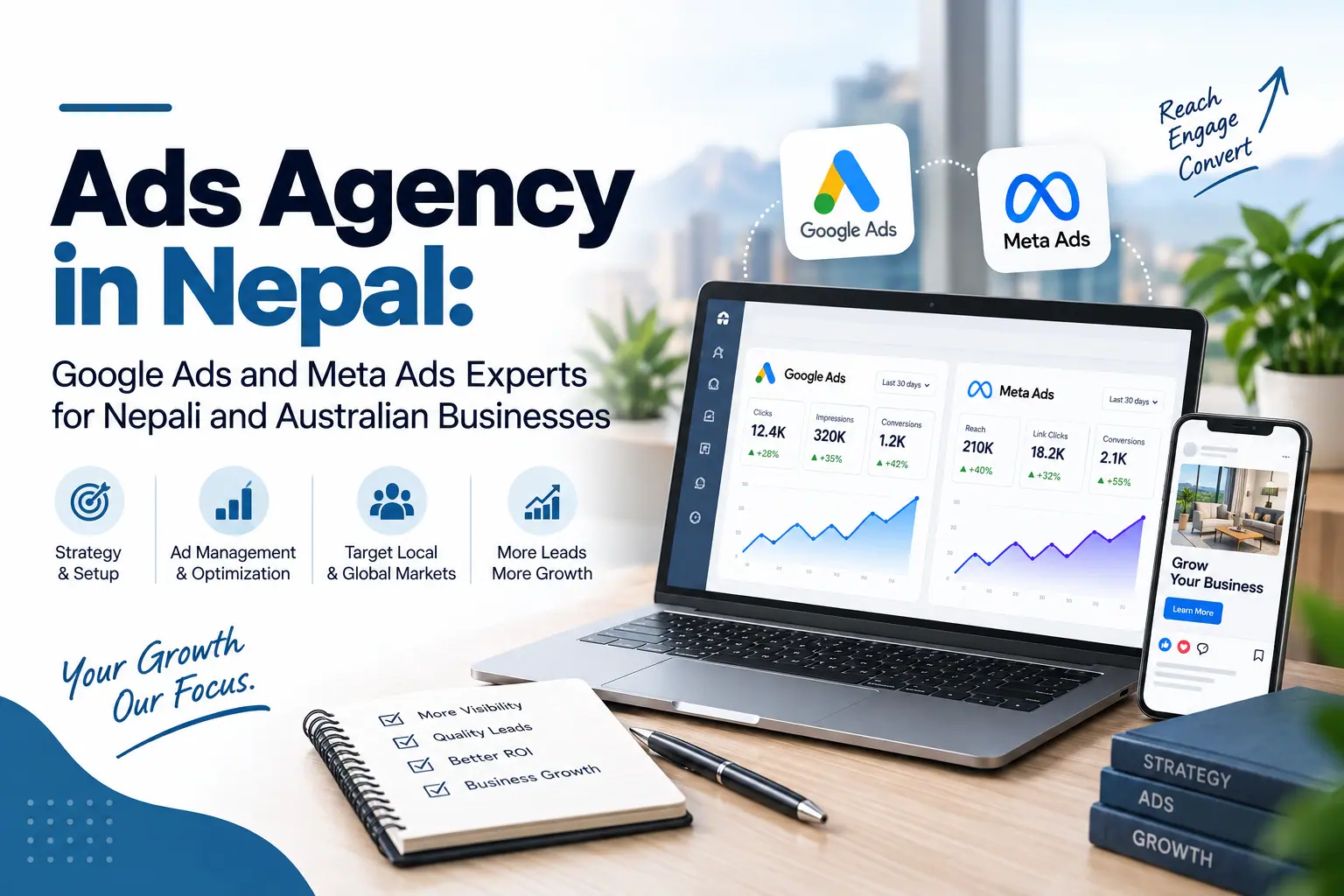
Running paid advertisements is easy. Building campaigns that reach relevant customers, generate qualified enquiries and produce measurable commercial value requires stronger planning, accurate tracking and continuous review.
Gripas Marketing is an ads agency in Nepal managing Google Ads and Meta Ads for Nepali businesses and Australian companies working with a Nepal-based marketing team.
Campaign support can include research, strategy, account setup, keyword and audience planning, advertising creative, conversion tracking, landing pages, retargeting, budget management and performance reporting.
This guide explains what an ads agency does, when Google Ads or Meta Ads may be suitable, why Australian businesses outsource campaign management to Nepal and what to examine before choosing an agency.
What does an ads agency in Nepal do?
An ads agency in Nepal plans and manages paid campaigns across platforms such as Google, Facebook, Instagram and YouTube.
Its responsibilities can include market research, keyword planning, audience selection, advertising creative, campaign setup, conversion tracking, landing page assessment, retargeting, budget management and performance reporting.
Google Ads is generally used to reach people actively searching for a product, service or solution. Meta Ads can introduce an offer visually, generate demand and reconnect with people who have already interacted with the business.
Businesses do not always need both platforms. The right advertising mix depends on customer intent, market competition, budget, available creative, website quality, tracking accuracy and the value of a completed sale or qualified lead.
What should businesses know before investing in paid advertising?
- Google Ads can capture demand from customers already searching for a product or service.
- Meta Ads can create awareness, demonstrate an offer and support retargeting.
- Campaign performance depends on the offer, creative, targeting, landing page, tracking and follow-up process.
- A low cost per lead does not always indicate that the leads are qualified.
- Automated campaigns still require accurate goals, useful data and informed oversight.
- Australian businesses can outsource execution to Nepal while retaining ownership of their advertising accounts.
- Advertising spend and agency management fees should be reported separately.
- Reporting should connect campaign activity with leads, sales, revenue or other meaningful outcomes.
- No agency can responsibly guarantee a fixed return, lead volume or advertising position.
- Businesses should assess their offer and sales process before increasing the advertising budget.
What Does an Ads Agency in Nepal Actually Do?
An ads agency in Nepal plans, launches, monitors and improves advertising campaigns across Google, Facebook, Instagram, YouTube and other eligible placements. The work may include research, strategy, keywords, audiences, creative production, account setup, conversion tracking, landing page recommendations, retargeting and reporting.
Campaign management should begin before an advertisement is published. The agency first needs to understand what the business sells, who is likely to buy, where those customers are located and which customer action has commercial value.
For one business, a successful conversion may be a completed ecommerce purchase. For another, it could be a qualified phone call, appointment, application, quotation request, restaurant reservation or submitted lead form.
Google Ads management
Google Ads can reach people across Search, YouTube, Maps, Display, Discover, Gmail and other eligible Google inventory. The appropriate campaign type depends on whether the business wants sales, leads, calls, store visits, product purchases or wider market exposure.
Google Ads management may include:
- Commercial keyword and search-intent research
- Campaign and ad group planning
- Search campaign management
- Performance Max campaign management
- Display and YouTube advertising
- Google Merchant Center coordination
- Search advertisement copywriting
- Negative keyword development
- Location and service-area targeting
- Call and lead-form conversion tracking
- Remarketing audience setup
- Search-term analysis
- Bid and budget optimisation
- Landing page assessment
- Campaign reporting
Performance Max is a goal-based Google Ads campaign that can access multiple Google channels from one campaign. Advertisers provide conversion goals, budgets, audience signals and creative assets, while Google automates parts of bidding, placement and campaign delivery.
Automation does not remove the need for strategy. If the wrong conversion action is selected, the campaign can optimise towards an activity that appears successful in the advertising account but produces little commercial value.
For example, a campaign may record many form submissions while attracting job seekers, existing customers, suppliers, people outside the service area or prospects seeking a service the company does not offer. Lead quality should therefore be reviewed alongside cost per conversion.
Meta Ads management
Meta Ads allow businesses to advertise across Facebook, Instagram and other eligible Meta placements. Campaigns can support awareness, engagement, website visits, lead generation, ecommerce sales and retargeting.
Meta Ads management may include:
- Campaign strategy and funnel planning
- Facebook and Instagram campaign setup
- Customer and audience research
- Lead-generation campaigns
- Ecommerce and sales campaigns
- Image and short-form video creative
- Advertising copy and offer development
- Meta Pixel configuration
- Conversion API coordination
- Custom audience development
- Lookalike audience development
- Website visitor retargeting
- Customer-list retargeting
- Creative testing
- Budget and placement analysis
- Lead-quality reporting
Meta Advantage+ uses automation across areas such as audience delivery, placement and campaign setup. The platform can process more campaign signals than a person could review manually, but it still depends on accurate conversion data, appropriate creative and a commercially relevant offer.
Creative has a particularly important role on Facebook and Instagram because people are normally browsing content rather than actively searching for an advertiser. The advertisement must first gain attention and then give the customer a reason to consider the offer.
A technically correct campaign can still struggle if the creative is repetitive, unclear or poorly matched to the intended audience. Businesses may need several images, short videos, messages and offer angles before they can assess which combination attracts useful enquiries.
Conversion tracking and landing pages
Clicks do not reveal whether advertising has produced a sale or qualified lead. Campaign tracking should therefore focus on the actions that indicate meaningful customer progress.
Depending on the business, these actions may include:
- Telephone calls
- WhatsApp enquiries
- Contact form submissions
- Appointment bookings
- Quotation requests
- Completed purchases
- Checkout completion
- Restaurant reservations
- Applications
- Qualified CRM opportunities
The landing page must also continue the promise made in the advertisement. A visitor should be able to understand the offer, intended customer, service area, supporting evidence and next step without searching through unrelated website sections.
Campaign reporting and commercial interpretation
Advertising reports should distinguish between platform activity and business outcomes. Impressions, reach and clicks can help diagnose delivery, but they do not show whether the campaign is commercially successful.
A useful report may include advertising spend, qualified leads, sales, revenue, cost per acquisition, conversion value, lead-to-sale rate, return on advertising spend and recommended campaign changes.
Gripas Marketing connects advertising with creative production, website and landing page development, conversion tracking, CRM pipelines and marketing automation. This helps identify whether a performance problem begins with the advertisement, landing page, tracking setup or follow-up process.
Why Are Nepali Businesses Investing in Professional Ads Management in 2026?
Nepali businesses use professional ads management when their internal teams lack the time, platform knowledge, creative capacity or measurement systems required to manage campaigns consistently. An agency can bring strategy, media buying, creative development, tracking and reporting into one connected process.
Professional campaign management is not automatically suitable for every company. Advertising works best when the business has a clear offer, an identifiable customer, a suitable landing page, enough capacity to serve new demand and a reliable method for handling enquiries.
Advertising platforms are becoming more automated
Google and Meta increasingly use automated systems to decide how campaigns are delivered. Google Performance Max can serve ads across multiple Google channels, while Meta Advantage+ can automate parts of sales, lead and app campaigns.
Automation can reduce some repetitive account work, but it makes the quality of the advertiser’s inputs more important.
Automated campaigns still need:
- Accurate conversion tracking
- Clear campaign objectives
- Relevant customer information
- Strong creative assets
- Suitable geographic settings
- Defined exclusions
- Realistic budgets
- Lead-quality feedback
- Commercially meaningful reporting
If a campaign is instructed to maximise form submissions, it may find users who frequently complete forms. It does not automatically know which enquiries became qualified customers unless that information is returned through the company’s tracking or CRM process.
Local competition requires more precise targeting
A business in Kathmandu may compete with many companies offering comparable products or services. Reaching a larger audience does not resolve that problem when the offer and message are indistinguishable from the competing advertisements.
A local campaign should answer several practical questions:
- Which cities, neighbourhoods or service areas can the business cover?
- Should the campaign target Kathmandu only or customers throughout Nepal?
- Which language does the intended audience prefer?
- Is the landing page suitable for mobile visitors?
- Can the business respond during the hours when advertisements run?
- What makes the offer useful to the intended customer?
- Does the landing page accurately reflect the advertisement?
- Can the sales team identify the source and quality of each enquiry?
Location targeting must reflect how the business operates. A restaurant normally needs customers within a realistic travel area, while an ecommerce store may be able to deliver throughout Nepal. A B2B company may target decision-makers nationally but exclude irrelevant consumer searches.
Advertising must connect with the sales process
Many campaigns lose value after an enquiry is generated. A visitor may submit a form but receive no response until the next day. A missed call might never be returned, or a WhatsApp enquiry may be answered without recording its campaign source.
The complete conversion path should therefore be examined:
- The customer sees the advertisement.
- The customer clicks or submits a lead form.
- The business receives the enquiry.
- A team member responds.
- The lead is assessed.
- A sale, booking or next action is recorded.
- The campaign is evaluated using lead quality and commercial value.
Gripas Marketing supports the wider journey through paid advertising, website development, SEO, creative content, CRM implementation and marketing automation. The aim is to connect customer discovery, website visits, advertising and follow-up rather than manage each activity separately.
Businesses need clearer budget decisions
An advertising budget should be assessed against the likely value of the customer, expected conversion rate, sales cycle, market competition and amount of data required to evaluate performance.
A small budget may still be useful for a focused campaign, but dividing it across too many products, locations, audiences and platforms can prevent any campaign from collecting enough information to support a decision.
Businesses comparing advertising management with wider marketing expenditure can review our pricing packages and learn how much digital marketing services cost in Nepal.
Why Do Australian Businesses Outsource Google Ads and Meta Ads to Nepal-Based Agencies?
Australian businesses may outsource paid advertising to a Nepal-based agency to access campaign management, creative support, landing page skills and reporting without building a complete internal advertising team. The arrangement is strongest when the Australian business retains control of its accounts, market strategy and customer relationships while the Nepal-based agency manages agreed delivery.
Lower operating costs can be relevant, but price alone is not a reliable reason to select an offshore agency. The agency must also understand the target market, communicate clearly, work within the client’s operational requirements and connect advertising reports with genuine lead quality.
Access to a broader marketing team
A paid advertising programme can require several capabilities:
- Google Ads management
- Meta Ads management
- Copywriting
- Graphic design
- Video editing
- Landing page development
- Conversion tracking
- Analytics
- CRM configuration
- Performance reporting
Recruiting a separate internal employee for each capability may not be practical for a small or medium-sized Australian business. Outsourcing can provide access to a coordinated delivery team without requiring the company to create an entire marketing department.
Businesses assessing this approach can read about outsourcing digital marketing to Nepal and working with a digital marketing agency for Australian businesses.
Working across the Nepal and Australia time difference
Australia uses multiple time zones, and the available overlap changes according to the client’s city and daylight-saving period. The working arrangement should therefore be planned around the relevant Australian location rather than treating the country as one time zone.
A practical offshore arrangement should define:
- Regular meeting times
- Primary communication channels
- Campaign approval procedures
- Expected response times
- Responsibility for urgent account issues
- Reporting frequency
- Advertising account permissions
- Creative review and revision procedures
- Lead-quality feedback
Some delivery work can occur before the next Australian business day begins, but time-zone differences should be managed as an operational consideration rather than promoted as an automatic advantage.
Australian market knowledge remains essential
Knowing how to operate an advertising platform is not the same as understanding an Australian customer. Campaigns should reflect Australian English, genuine service areas, local buying behaviour, seasonal demand, applicable advertising requirements and the company’s operational capacity.
The Australian client should provide market knowledge, customer information, pricing boundaries, service areas and commercial context. The agency can then translate this information into campaign structure, targeting, creative production, landing pages and reporting.
For service businesses, paid advertising may also need to work with local SEO, Google Business Profile visibility, website content and lead follow-up. The Gripas Marketing guide to digital marketing for Australian service businesses explains this wider approach.
Cleaning companies can also explore Meta Ads for Australian cleaning businesses and methods for getting more cleaning clients in Australia.
Account ownership and reporting must remain transparent
An Australian business should understand:
- Who owns the Google Ads and Meta Ads accounts
- Who controls billing and payment methods
- Which team members have account access
- How campaign changes are documented
- How leads, sales and revenue are measured
- Which costs are advertising spend
- Which costs are agency management fees
- What happens when the working relationship ends
Where practical, the client should own the core advertising accounts and grant the agency the access needed to manage them. This protects campaign history, audiences, conversion information and continuity.
Outsourcing should increase the company’s marketing capacity without creating avoidable dependency on a supplier.
Google Ads vs Meta Ads Agency: Which One Does Your Business Need?
Choose Google Ads when customers are already searching for the product, service or problem your business solves. Choose Meta Ads when you need to introduce an offer, generate awareness, demonstrate value visually or retarget people who have already interacted with the company.
Some businesses benefit from using both platforms, but only when their budget, customer journey, creative resources and tracking setup support a combined strategy.
| Decision factor | Google Ads | Meta Ads |
|---|---|---|
| Customer behaviour | Actively searching for a product, service or solution | Browsing Facebook or Instagram content |
| Typical campaign role | Capturing existing demand | Generating and developing demand |
| Targeting basis | Keywords, search intent, audiences, location and campaign signals | Audiences, customer data, engagement, location and platform signals |
| Useful creative | Search copy, product feeds, images and video depending on campaign type | Images, vertical videos, demonstrations, customer stories and offer-led creative |
| Common use cases | Local services, urgent needs, professional services, ecommerce and high-intent enquiries | Ecommerce, hospitality, events, visual services, awareness, lead generation and retargeting |
| Main risk | Paying for irrelevant or poorly qualified searches | Reaching users who engage with the advertisement but have limited buying intent |
| Important measurement | Search terms, qualified conversions, conversion value and acquisition cost | Creative performance, lead quality, frequency, conversion rate and acquisition cost |
| Useful starting condition | Customers already search for what the business provides | The business has a clear visual offer and enough creative to test |
| Retargeting role | Reconnect with previous visitors across eligible Google inventory | Reconnect with website visitors and engaged social audiences |
| Landing page requirement | Strong alignment between the search, advertisement and landing page | Strong continuity between the creative, offer and landing experience |
When Google Ads may be the better starting point
Google Ads may be suitable when the customer has a clear need and actively searches for a provider, product or solution.
Possible use cases include:
- Emergency repair services
- Accountants and legal services
- Mortgage and finance-related services
- Education and training providers
- Hotels and travel services
- Healthcare providers
- B2B software and professional services
- Local contractors
- High-intent ecommerce products
Search campaigns can connect a company with people already expressing intent through their search terms. This does not make every click valuable. Keyword selection, negative keywords, geographic targeting, advertising copy and landing page relevance still affect traffic quality.
When Meta Ads may be the better starting point
Meta Ads may be suitable when customers are unlikely to search for the offer before seeing it or when the product needs visual explanation.
Possible use cases include:
- New consumer products
- Fashion and lifestyle products
- Restaurants and events
- Fitness offers
- Beauty services
- Visual home-improvement services
- Time-sensitive promotions
- Community-focused campaigns
- Products that require a demonstration
Meta can also generate leads for service companies, but performance should be evaluated using qualified enquiries and customer outcomes rather than inexpensive form submissions alone.
Before increasing campaign spend, businesses should determine whether their Meta Ads budget is producing meaningful performance. They can then use appropriate Meta Ads retargeting strategies to reconnect with people who visited the website or engaged with the company.
When a combined strategy makes sense
Google Ads and Meta Ads can support different stages of the same buying process.
- A potential customer sees a video advertisement on Instagram.
- The customer visits the company’s website.
- The customer leaves without making an enquiry.
- Several days later, the customer searches for the service on Google.
- The customer compares the company with other providers.
- A retargeting advertisement brings the customer back.
- The customer submits a quotation request.
If only the final interaction is reviewed, the business may undervalue the advertisements that first introduced the company or supported the customer’s decision.
A combined strategy is more practical when the company has:
- A sufficient testing budget
- Reliable conversion tracking
- Several usable creative assets
- A clear and competitive offer
- Suitable landing pages
- A defined follow-up process
- Enough conversion volume to evaluate performance
It may not be practical when the business has a very limited budget, uncertain demand or no capacity to respond to additional enquiries. In that situation, one carefully selected platform can be easier to evaluate.
How Do You Choose the Right Ads Agency in Nepal?
Choose an ads agency in Nepal by examining its planning process, platform capabilities, tracking standards, account ownership policy, reporting quality and understanding of your target market. Avoid selecting an agency only because it promises low-cost clicks, immediate returns or a guaranteed number of leads.
A responsible agency should also be willing to identify situations where paid advertising is not yet the right investment.
Does the agency understand the commercial goal?
The agency should know whether the campaign needs to generate:
- Sales
- Qualified leads
- Calls
- Bookings
- Store visits
- Applications
- Product purchases
- Customer retention
- Market awareness
More traffic may support one of these goals, but it is not a complete commercial objective by itself.
Can the agency recommend the appropriate platform?
An agency that manages both Google Ads and Meta Ads should be able to recommend a platform based on customer behaviour rather than forcing every client into the same campaign model.
Using both platforms should not be treated as a requirement. The agency should explain why each platform is relevant, what role it will play and which outcome will be used to assess its contribution.
How will conversion tracking be handled?
The agency should explain:
- Which actions will count as conversions
- How calls, forms, bookings or purchases will be tracked
- How duplicate conversion events will be prevented
- How lead quality will be assessed
- Whether sales information can be connected with the campaign
- Who is responsible for website or CRM implementation
- How tracking problems will be identified
Automated advertising systems depend heavily on the conversion information supplied to them. Incorrect measurement can result in incorrect optimisation.
Who owns the advertising accounts and campaign data?
The business should understand who controls:
- Google Ads
- Meta Business Manager
- Meta Ads Manager
- Google Analytics
- Google Tag Manager
- Google Merchant Center
- Tracking pixels
- Customer audiences
- Landing pages
- Advertising creative
- Billing information
Ownership and access should be established before advertising begins rather than after the business decides to change providers.
Does reporting cover meaningful business outcomes?
Useful reporting should extend beyond impressions, reach and clicks. Depending on the campaign, reports may need to include:
- Advertising spend
- Qualified leads
- Purchases
- Revenue
- Cost per qualified lead
- Cost per acquisition
- Conversion value
- Return on advertising spend
- Lead-to-sale rate
- Search-term quality
- Creative performance
- Geographic performance
- Recommended actions
A performance report should help the business decide whether to continue, change, expand or stop an activity. It should not merely repeat figures already available inside the advertising dashboard.
Can the agency support creative and landing pages?
Campaign performance can be restricted when an agency manages media buying but cannot improve the advertisement or destination page.
Google Ads management
Plan and manage Search, Performance Max, Display, YouTube and eligible remarketing campaigns.
Meta Ads management
Manage Facebook and Instagram campaigns for awareness, leads, sales and retargeting.
Advertising creative
Develop advertisement copy, graphics, short videos and campaign-specific creative variations.
Landing page development
Build or improve campaign pages to support clarity, usability, tracking and conversions.
Conversion tracking
Measure relevant calls, lead forms, bookings, purchases and other customer actions.
CRM and follow-up
Connect campaign enquiries with pipelines, notifications and appropriate follow-up workflows.
Gripas Marketing combines paid advertising with creative production, website development, landing pages, SEO, CRM and marketing automation. This allows campaign problems to be examined across the customer journey rather than attributed automatically to targeting or bidding.
Does the agency make realistic claims?
Be cautious when an agency guarantees:
- First position in every advertising auction
- A fixed return without reviewing the business
- A specific number of sales regardless of budget
- Immediate and consistent profitability
- Extremely low conversion costs in a competitive market
- Results without conversion tracking
- Success without access to business information
Advertising performance is influenced by the offer, market demand, competition, budget, creative quality, website, pricing, sales process and customer behaviour.
Businesses comparing providers can review this guide to choosing the right digital marketing partner and learn more about selecting the best digital marketing agency in Kathmandu.
Discuss your Google Ads or Meta Ads campaign with Gripas Marketing
Gripas Marketing manages Google Ads and Meta Ads for businesses operating in Nepal and Australia. Campaign support can include strategy, research, account setup, creative production, conversion tracking, landing pages, retargeting, optimisation and reporting.
Every engagement begins with the business goal, intended market, current marketing setup, customer journey and available budget. The recommended platform and campaign structure are then selected according to those conditions.
The proposal does not guarantee a fixed number of leads, sales or a predetermined return. It defines the recommended scope, responsibilities, assumptions and performance indicators for the campaign.
Frequently Asked Questions
What is an ads agency in Nepal?
An ads agency in Nepal plans and manages paid campaigns across platforms such as Google, Facebook, Instagram and YouTube. Its responsibilities can include research, targeting, creative development, campaign setup, conversion tracking, optimisation and reporting.
How much does it cost to hire a Google Ads agency in Nepal?
The cost depends on campaign scope, advertising spend, number of platforms, creative requirements, landing pages, tracking complexity and reporting needs. The advertising budget paid to Google or Meta should be separated from the agency’s management fee.
Is Google Ads or Meta Ads better for a Nepali business?
Google Ads is often suitable when customers actively search for a product or service, while Meta Ads can support awareness, visual promotion, lead generation and retargeting. The better platform depends on customer intent, the offer, budget, market competition and available creative.
Can an Australian business hire a Nepal-based ads agency?
Yes. An Australian business can hire a Nepal-based agency for Google Ads, Meta Ads, creative support, landing pages, tracking and reporting while retaining ownership of its advertising accounts and customer relationships.
How long does paid advertising take to produce results?
Campaigns can begin generating traffic or enquiries shortly after they are approved, but reliable evaluation normally requires more data. The required period depends on budget, conversion volume, market demand, sales cycle, creative quality and lead value.
Can Gripas Marketing guarantee a particular advertising return?
No agency can responsibly guarantee a fixed return before or during a campaign. Gripas Marketing can improve campaign structure, creative, landing pages, tracking, reporting and optimisation, but results also depend on the market, offer, budget and sales process.
Related Gripas Marketing resources
- Digital Marketing Agency for Australian Businesses
- Digital Marketing Outsourcing from Nepal to Australia
- Digital Marketing for Australian Service Businesses
- Meta Ads for Australian Cleaning Businesses
- How to Get More Cleaning Clients in Australia
- AI Search and AEO for Australian Businesses
- Digital Marketing Price Packages in Nepal
- Digital Marketing Services Cost in Nepal
- Meta Ads Budget and Campaign Performance
- Meta Ads Retargeting Strategies
- How to Choose a Digital Marketing Agency in Nepal
- Digital Marketing Agency in Kathmandu
- Explore Digital Marketing Services
- View the Gripas Marketing Portfolio
- About Gripas Marketing
- Request a Custom Proposal
- Contact Gripas Marketing
Platform sources and practical limitations
- Google Ads Help: About Performance Max Campaigns
- Google Ads: Performance Max
- Google Ads API: Performance Max Requirements
- Meta Blueprint: Meta Advantage+
Google Ads and Meta Ads features, campaign types, reporting options and automated systems can change. Review the current platform documentation before making major account or campaign changes.
Paid advertising can improve customer reach and generate measurable campaign activity. It cannot guarantee a particular number of enquiries, sales, customers or a fixed return because results depend on the offer, budget, market, competition, creative, website and sales process.