


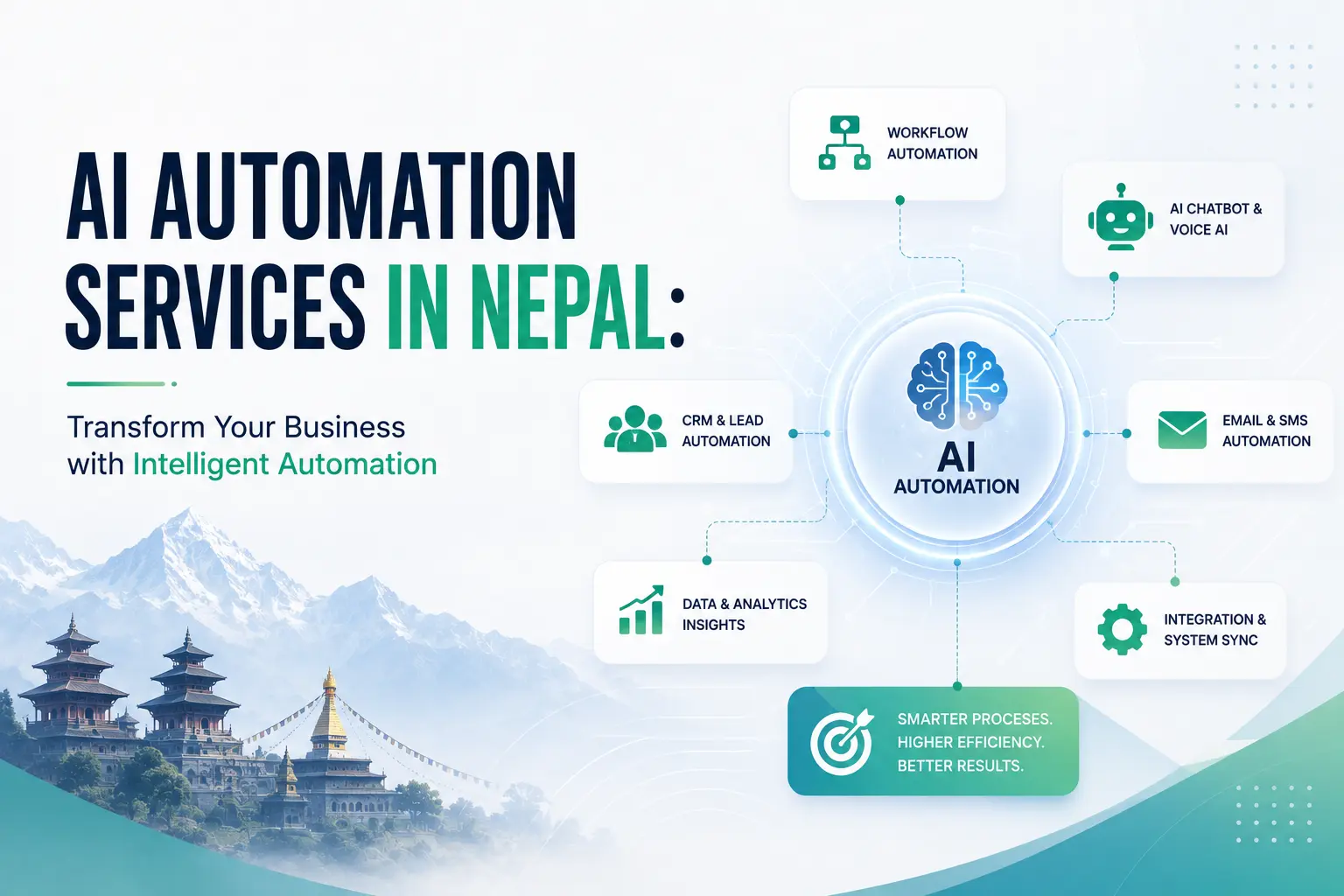
Businesses in Nepal are adopting more digital tools, but many everyday processes still depend on manual data entry, employee memory, disconnected spreadsheets and repeated customer communication. Leads can remain unanswered, reports take hours to prepare and important follow-ups are easily missed when systems do not work together.
AI automation services in Nepal help organisations connect their data, software, customer communication and internal workflows so repetitive work can be completed faster, more accurately and with greater visibility.
Effective AI automation is not limited to adding a chatbot to a website. It can classify enquiries, update a CRM, qualify leads, schedule appointments, extract document information, prepare reports, notify employees and escalate decisions that require human judgement.
Gripas Marketing is an AI automation agency in Nepal based in Kathmandu. We connect websites, advertising, CRM, customer communication, marketing and operational workflows into measurable systems for Nepalese organisations and international service businesses.
What Are AI Automation Services in Nepal?
AI automation services combine artificial intelligence, workflow automation, software integrations and business rules to complete repetitive tasks, process information, communicate with customers and support employee decision-making.
Businesses can use AI automation for lead management, sales follow-up, customer support, appointments, marketing, document processing, reporting and internal administration. The most reliable systems automate predictable work while sending uncertain, sensitive or high-impact decisions to an authorised employee.
The goal is not to add AI everywhere. The goal is to identify measurable operational problems and build the smallest reliable automation that improves speed, consistency, visibility or customer experience.
Key Takeaways
- AI automation services in Nepal can connect customer communication, CRM, marketing and internal operations.
- AI automation is broader than chatbot development and can support complete business workflows.
- High-value starting points include lead response, appointment reminders, support routing, document handling and reporting.
- Workflow automation follows rules, while AI can interpret conversations, documents and other unstructured information.
- Human approval should remain in place for sensitive, unusual or high-impact decisions.
- A process should be documented before technology is selected or automation is built.
- Small businesses can begin with one measurable workflow and expand after results are verified.
- Successful implementation requires testing, monitoring, documentation and employee training.
- The right AI automation agency in Nepal should understand both technology and business operations.
- Gripas Marketing connects automation with websites, lead generation, CRM and reporting rather than treating it as an isolated tool.
Why Do Nepalese Businesses Need AI Automation Services?
Nepalese businesses need AI automation when growth creates more enquiries, data, tasks and customer expectations than manual processes can manage consistently.
A manual process can appear inexpensive while the business is small. As volume increases, hidden costs become visible. Employees copy information between tools, search message threads, prepare the same updates repeatedly and rely on memory to complete follow-ups. These problems reduce response speed and make performance difficult to measure.
Slow Lead Response
Enquiries wait in inboxes or messaging applications while potential customers contact competitors.
Missed Follow-Ups
Sales and service communication depends on individual memory instead of a controlled process.
Repeated Data Entry
Employees copy names, numbers, orders and status updates between forms, sheets and software.
Disconnected Reporting
Managers spend time combining data and still cannot see the complete customer journey.
Inconsistent Service
Customers receive different information depending on who responds and which channel they use.
Limited Capacity
Business growth requires more administrative effort because the underlying workflow does not scale.
AI automation should remove friction from a defined process. It should not automate confusion, hide responsibility or make important decisions impossible to review.
Which AI Automation Services Are Available in Nepal?
AI automation services in Nepal can cover customer-facing communication, internal workflows, CRM operations, sales, marketing, reporting and custom software integration.
AI Workflow Automation
Connect repetitive tasks, approvals, notifications and data movement into controlled workflows.
AI Agents
Deploy goal-focused assistants for lead qualification, support, research, scheduling and internal operations.
AI Chatbots
Provide approved answers, collect customer details and escalate conversations to the correct employee.
AI Voice Agents
Support inbound or outbound calls, qualification, reminders and appointment workflows where appropriate.
WhatsApp Automation
Capture enquiries, send approved updates, route replies and maintain human handover paths.
CRM Automation
Create contacts, update fields, assign owners, move opportunities and trigger structured follow-up.
Marketing Automation
Connect campaigns, lead capture, nurturing, segmentation and performance reporting.
Sales Automation
Automate lead routing, qualification, reminders, proposal follow-up and pipeline notifications.
Customer Support Automation
Classify requests, retrieve approved knowledge, create tickets and escalate complex cases.
Document Automation
Extract, categorise, validate and route information from forms, invoices and business documents.
Reporting Automation
Collect data from connected systems and deliver scheduled operational or marketing reports.
Custom AI Integrations
Connect websites, CRMs, databases and business platforms using APIs and webhooks.
These services can be implemented separately or connected into one customer journey. For example, a website enquiry can be interpreted by AI, saved in the CRM, assigned to the right employee, followed by an appointment link and included in a reporting dashboard.
Which Business Processes Can Be Automated with AI?
The best automation candidates are repetitive, high-volume processes with identifiable triggers, defined data and clear outcomes.
Lead Management Automation
- A prospect submits a website form or sends a message.
- The system captures the contact and source.
- AI identifies the requested service and relevant details.
- The lead is assigned to the correct pipeline or employee.
- The prospect receives an approved response or booking option.
- Unanswered enquiries enter a controlled follow-up sequence.
- Management can review source, response and conversion data.
Customer Support Automation
A customer message can be classified, matched with approved knowledge and routed according to urgency. Routine questions can receive fast answers, while uncertain, sensitive or dissatisfied customers are transferred to a person.
Sales Automation
Sales workflows can assign leads, create opportunities, remind representatives, prepare internal summaries, follow up after proposals and update pipeline visibility. AI should assist the sales team without inventing prices, commitments or unsupported product claims.
Marketing Automation
Marketing systems can connect campaign leads, segmentation, email sequences, content approvals, social publishing and performance reporting. AI may assist with drafting or classification, while brand, factual and compliance review remains controlled.
Document and Administrative Automation
Automation can extract structured information from forms or documents, validate required fields, request missing information, route approvals and update connected records. Low-confidence extraction should be flagged for human checking.
Reporting Automation
Data from advertising platforms, websites, CRM systems and operational tools can be collected into recurring reports. A useful report should explain the source, timing and limitations of the data rather than presenting an unexplained AI-generated conclusion.
Which Industries Can Use AI Automation in Nepal?
AI automation can support almost any industry with repeatable enquiries, documents, approvals, appointments, customer communication or reporting.
Education Consultancies
Qualify student enquiries, collect programme preferences, schedule counselling and track application stages.
Travel and Tourism
Answer common trip questions, organise requests, capture traveller details and route custom itineraries.
Hotels and Hospitality
Handle common enquiries, booking requests, pre-arrival communication and feedback workflows.
Hospitals and Clinics
Support appointment requests, reminders and administrative routing while preserving human oversight.
Real Estate
Capture buyer or seller requirements, assign agents, schedule inspections and follow up with prospects.
Retail and E-commerce
Automate order updates, frequently asked questions, product enquiries and customer-service routing.
Professional Services
Manage enquiries, consultations, document requests, proposals and recurring client communication.
Recruitment Agencies
Categorise applications, organise candidate data, schedule interviews and send status notifications.
Software Companies
Route support requests, qualify product leads, support onboarding and automate internal reporting.
Manufacturing and Distribution
Connect procurement, inventory notifications, approvals, documentation and operational reporting.
Marketing Agencies
Automate lead handling, client onboarding, campaign tasks, approvals, dashboards and reporting.
Financial Services
Support controlled document collection, case routing and service communication with appropriate governance.
Industry context matters. A clinic appointment workflow, education counselling journey and real estate enquiry pipeline require different data, language, escalation rules and reporting. Generic templates should be adapted before they process real customer information.
What Are the Benefits of AI Automation for Businesses in Nepal?
The practical benefits of AI automation include faster responses, more consistent execution, reduced repetitive work and clearer operational visibility.
- Respond to new enquiries more quickly
- Reduce missed sales and service follow-ups
- Give employees more time for judgement and relationship-building
- Improve consistency across customer communication
- Reduce avoidable copying and data-entry errors
- Connect information across business tools
- Keep pipeline and task status visible
- Support customers outside standard office hours where appropriate
- Create repeatable onboarding and administrative processes
- Generate regular reports without manual consolidation
- Scale selected operations without increasing repetitive workload at the same rate
- Create audit points and accountability for automated actions
Benefits should be measured against a baseline. Useful measures include first-response time, follow-up completion, appointment rate, processing time, error rate, employee hours, escalation rate and customer outcomes.
What Is the Difference Between Workflow Automation, AI Automation and AI Agents?
Workflow automation executes defined rules, AI automation interprets less-structured information and AI agents pursue approved objectives through connected actions.
Workflow Automation
When a form is submitted, create a CRM contact, assign an owner and send a confirmation. The trigger and actions are predefined.
AI Automation
Read an enquiry, identify the service and urgency, prepare an approved response and route the contact using interpreted information.
AI Agent
Work toward an approved objective such as qualifying a lead, offering an appointment and updating the CRM within defined boundaries.
Many reliable business systems combine all three. Rules control predictable actions, AI assists with interpretation and employees approve exceptions or important decisions.
How Are AI Automation Services Implemented?
AI automation should be implemented through process discovery, controlled design, integration, testing, training and continuous monitoring.
- Identify the problem: Define the delay, error, cost, missed opportunity or customer issue.
- Map the current process: Document triggers, steps, data, decisions, owners and exceptions.
- Set a measurable outcome: Select response time, completion rate, saved hours, conversion or another meaningful measure.
- Review data and systems: Assess quality, access, consent, security and integration options.
- Choose the automation boundary: Separate predictable tasks from decisions requiring human judgement.
- Design the workflow: Define actions, prompts, validations, approvals, error handling and audit points.
- Build the connections: Integrate the website, CRM, communication channels, databases and reporting tools.
- Test edge cases: Test incomplete data, duplicate contacts, unusual messages, failed integrations and opt-outs.
- Launch a controlled pilot: Begin with limited scope and closely monitor performance.
- Train and document: Explain system ownership, escalation, manual override and maintenance.
- Measure and improve: Compare results with the baseline and refine the process.
Start with one process that has a clear owner and measurable outcome. Prove the value, improve the controls and then expand.
Why Is Human-in-the-Loop AI Automation Important?
Human-in-the-loop automation keeps authorised employees involved when a decision is sensitive, uncertain, unusual or capable of causing significant impact.
Human review may be required for pricing exceptions, contractual commitments, financial approvals, employment decisions, health-related communication, complaints, refunds, legal matters and low-confidence document interpretation.
- Set confidence thresholds for AI outputs.
- Define when a conversation must be escalated.
- Keep a manual override for critical workflows.
- Record important automated actions.
- Limit system access to required data and functions.
- Review outputs and failure patterns regularly.
- Tell customers when they are interacting with an automated system where appropriate.
Which Tools Can Be Used for AI Automation?
The technology should be selected after the workflow, data requirements, security conditions and maintenance responsibilities are understood.
CRM and Marketing Platforms
GoHighLevel, HubSpot and other CRM systems can coordinate contacts, opportunities, communication and reporting.
Workflow Platforms
Microsoft Power Automate, n8n, Make and Zapier can connect applications and execute business rules.
AI Services
Azure AI and suitable model providers can support classification, extraction, summarisation and conversational functions.
Communication Channels
Email, SMS, voice, website chat and WhatsApp can be connected with consent, routing and escalation controls.
Data and Reporting
Databases, spreadsheets, analytics platforms and dashboards can provide operational records and performance visibility.
Custom Integrations
APIs and webhooks can connect industry software when a reliable native integration is unavailable.
The correct stack depends on transaction volume, existing software, language requirements, integration access, data sensitivity, hosting, budget and the internal ability to maintain the system.
How Much Do AI Automation Services Cost in Nepal?
AI automation pricing in Nepal depends on the complexity and risk of the workflow rather than only the number of visible automation steps.
Workflow Scope
The number of processes, branches, approvals and exception paths affects design and testing effort.
Integrations
Native connectors are often simpler than custom API, webhook or legacy-system integrations.
AI and Communication Usage
Model usage, email, SMS, voice and WhatsApp services can create variable operating costs.
Data Preparation
Incomplete, duplicated or inconsistent information may require cleaning and restructuring.
Security and Governance
Permissions, audit logs, approval controls and sensitive-data requirements increase implementation responsibility.
Support and Maintenance
Monitoring, optimisation, documentation, training and platform changes affect ongoing cost.
Common commercial models include a one-time workflow build, paid discovery, proof of concept, monthly automation management, dedicated implementation support and custom software development. A responsible proposal should separate setup costs, recurring platform costs, usage charges and ongoing support.
How Should You Choose an AI Automation Agency in Nepal?
Choose an AI automation agency in Nepal that begins with the business process, identifies measurable outcomes and explains the limits, risks and maintenance requirements of the proposed system.
- The agency maps the current workflow before recommending tools.
- It can explain which steps should remain manual.
- It defines ownership, escalation and manual override.
- It understands CRM, APIs, webhooks and data mapping.
- It tests incomplete data and failure scenarios.
- It considers privacy, permissions and information access.
- It documents workflows and trains the team.
- It defines measurable success criteria.
- It provides realistic ongoing support and monitoring.
- It avoids unsupported promises about savings, accuracy or complete autonomy.
Turn Repetitive Work into a Connected AI Workflow
Gripas Marketing can review your existing process, identify practical automation opportunities and build a controlled system around your website, CRM, communication channels and business tools.
Why Choose Gripas Marketing as Your AI Automation Agency in Nepal?
Gripas Marketing connects AI automation with lead generation, websites, CRM, marketing, customer communication and reporting so automation contributes to a complete business outcome.
Many technical workflows fail to create value because they are disconnected from customer acquisition and daily operations. Gripas Marketing approaches automation as part of a connected growth system. We review how customers discover the business, submit enquiries, receive follow-up, book appointments, move through sales stages and appear in performance reports.
- AI automation strategy and process discovery
- CRM and pipeline implementation
- GoHighLevel setup and workflow automation
- AI-assisted lead qualification
- Website and landing-page integrations
- Email, SMS and WhatsApp workflow preparation
- Appointment and follow-up automation
- Customer-support routing
- Document and reporting workflows
- API and webhook integration
- Testing, documentation and employee training
- Ongoing monitoring and optimisation
Start with One High-Value Automation
You do not need to automate the entire business at once. Begin with a process that repeatedly consumes time, delays customers or causes missed revenue, then build a controlled pilot with a measurable result.
Frequently Asked Questions
What are AI automation services?
AI automation services combine artificial intelligence, workflow rules, software integrations and business data to complete repetitive tasks, interpret information and support business decisions. They can automate lead handling, customer support, reporting, document processing, appointments, marketing and internal operations.
Which businesses can use AI automation services in Nepal?
AI automation can support education consultancies, clinics, travel companies, hotels, real estate agencies, retailers, e-commerce businesses, software companies, professional services, manufacturers and other organisations. The best starting point is a repetitive process with clear inputs, decisions and measurable outcomes.
How much do AI automation services cost in Nepal?
The cost depends on workflow complexity, integrations, AI usage, communication volume, data preparation, security, custom development, training and ongoing support. Gripas Marketing prepares a custom proposal after reviewing the process and implementation requirements.
Can AI automation work with existing business software?
Yes, automation can often connect with CRM platforms, websites, forms, email, WhatsApp, calendars, accounting software, databases and reporting tools through native integrations, APIs or webhooks. Compatibility and data access should be assessed before implementation.
What is the difference between workflow automation and AI automation?
Workflow automation follows predefined rules for predictable tasks, while AI automation can interpret text, documents, conversations or other unstructured information. A reliable system often combines both approaches and keeps human approval for sensitive decisions.
Can AI automation replace employees?
AI automation is best used to reduce repetitive work and help employees respond faster and make better-informed decisions. Human oversight should remain in place for sensitive, unusual, financial, legal, medical or high-impact situations.
How long does an AI automation project take?
A simple workflow may be implemented relatively quickly after process discovery, while a multi-department system can require staged design, integration, testing and training. The timeline should be based on scope, data readiness and the number of connected systems.
Does Gripas Marketing build AI agents and chatbots?
Gripas Marketing can design AI-assisted customer communication, lead qualification, appointment, CRM and workflow systems according to business requirements. Every deployment should include approved knowledge, escalation rules, testing and monitoring.
Is AI automation suitable for small businesses in Nepal?
Yes, small businesses can begin with one high-value workflow such as enquiry follow-up, appointment reminders, quotation follow-up or reporting. Starting small reduces risk and creates evidence before the system is expanded.
Why choose an AI automation agency in Nepal?
A Nepal-based agency can understand local workflows, communication preferences, budgets and implementation conditions while providing accessible support. The agency should still demonstrate process mapping, integration, security, documentation and measurable delivery capabilities.
Related Gripas Marketing Resources
Editorial Sources
- Gripas Marketing: Connected Digital Growth Services
- Gripas Marketing Services
- Microsoft Power Automate Documentation
- Microsoft Azure AI Services Documentation
- n8n Documentation
- HighLevel CRM and Automation Platform
Implementation disclaimer: AI outputs and automation performance depend on the quality of data, process design, connected systems, testing and ongoing monitoring. Sensitive or high-impact decisions should remain subject to suitable human review.