


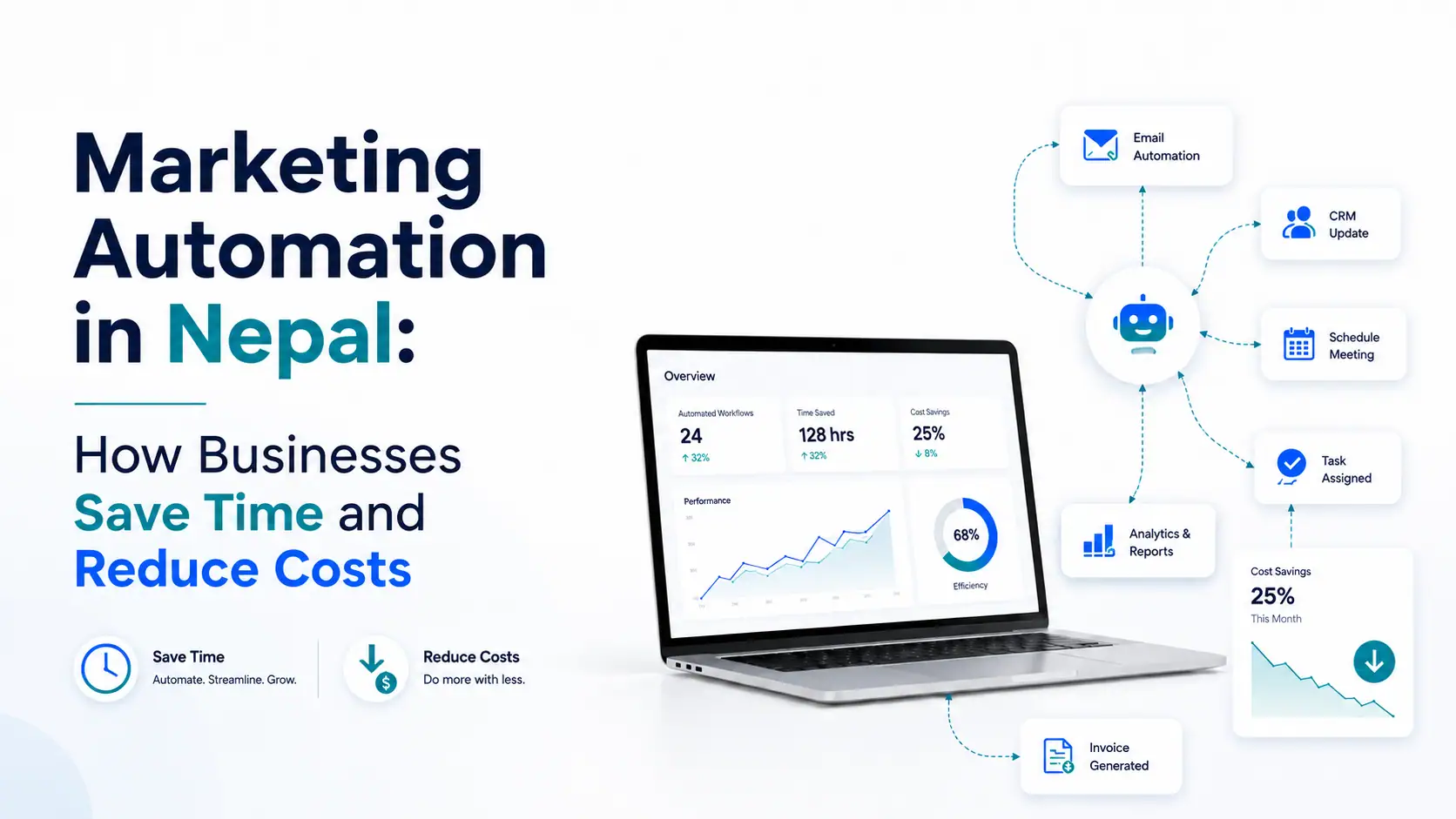
Nepali businesses are receiving customer enquiries through websites, Facebook, Instagram, WhatsApp, telephone calls, online advertisements and referrals. Generating enquiries is only the first step. Businesses must also respond quickly, record customer information, assign leads, schedule appointments and complete follow-ups consistently.
Many small and medium-sized businesses still manage these activities through spreadsheets, personal messaging accounts, notebooks and manual reminders. This approach may work when enquiry volume is low, but it can become difficult to manage as the business grows.
Marketing automation in Nepal helps businesses connect lead capture, customer communication, CRM pipelines, appointments, follow-ups and reporting within a more organised system. It reduces repetitive administrative work while keeping employees involved in sales conversations, customer support and important decisions.
Gripas Marketing is a marketing automation agency based in Kathmandu, Nepal. The agency helps businesses implement GoHighLevel CRM systems, automated lead follow-up, pipeline management, appointment reminders, review workflows and connected marketing processes.
What This Marketing Automation Guide Covers
Marketing automation is the use of software and predefined workflows to manage repetitive marketing, sales and customer communication activities. A business can use automation to capture leads, send immediate acknowledgements, assign enquiries, schedule appointments, deliver reminders, follow up with prospects, request reviews and track opportunities through a CRM.
This guide explains how businesses are adopting marketing automation in Nepal, which processes can be automated, how GoHighLevel supports CRM and communication workflows, how automation can save time, and when a business should or should not invest in automation.
It also explains the long-term value of centralised customer data and how to choose a GoHighLevel expert in Nepal. The objective is not to automate every customer interaction. The objective is to create a reliable system that reduces repetitive work without removing necessary human judgement.
Automation does not guarantee more leads, customers or revenue. Results depend on lead quality, customer demand, the business offer, workflow design, staff response, communication quality, system testing and ongoing optimisation.
Key Takeaways
- Marketing automation in Nepal can help businesses capture, organise and follow up with leads more consistently.
- Businesses can begin with one practical process instead of automating the complete customer journey at once.
- Common entry points include lead capture, appointment reminders, review requests and lead follow-up automation.
- GoHighLevel combines CRM records, pipelines, calendars, forms, workflows and customer communication within one platform.
- Automation becomes valuable when lead volume, repetition, delayed responses or inconsistent staff processes create measurable problems.
- A business receiving fewer than 10 leads per month may be able to manage enquiries manually without advanced automation.
- Automation should support employees rather than replace personal customer communication.
- Centralised CRM history can improve reporting, team accountability and long-term marketing decisions.
- Customer consent, privacy, secure access and opt-out procedures should be included in every automation system.
- Gripas Marketing provides GoHighLevel setup and CRM automation services from Kathmandu for businesses across Nepal.
Why Are Nepali Businesses Turning to Marketing Automation?
Nepali businesses are turning to marketing automation because manual lead management becomes difficult as enquiry volume and communication channels increase. A growing business may receive leads from website forms, Facebook campaigns, Instagram messages, WhatsApp, phone calls, Google Business Profile and referrals.
Without a central system, customer information can become scattered across employee phones, spreadsheets, advertising dashboards, email accounts and paper records. A lead may receive an initial answer but no second follow-up. Another prospect may be contacted by two employees because neither person can see the other conversation.
These problems are not always caused by poor employees. They are often caused by the absence of a defined system.
The Shift from Manual Follow-Up to Connected Systems
Many businesses begin with an informal sales process. One employee answers Facebook messages, another responds to telephone calls and the owner follows up with important leads personally. This process can work during the early stage of the business.
As the business grows, the same approach may create operational problems:
- New enquiries are not recorded in one place.
- Staff cannot see who is responsible for each lead.
- Customers receive different information from different employees.
- Appointment reminders are sent inconsistently.
- Follow-up depends on individual memory.
- Old enquiries remain unused after the first conversation.
- Management cannot identify where leads are being lost.
- Marketing reports show clicks and enquiries but not sales outcomes.
Marketing automation in Nepal provides a way to convert these informal activities into visible and repeatable workflows.
Why Kathmandu Is Leading Adoption
Kathmandu has a large concentration of educational consultancies, clinics, real estate companies, marketing agencies, software businesses, training institutions, hospitality companies, retail brands, salons and professional service providers.
These industries frequently manage enquiries, appointments, consultations, quotations and recurring follow-ups. As a result, demand for marketing automation in Kathmandu is closely connected to practical operational problems rather than interest in software alone.
A clinic may need appointment reminders. An educational consultancy may need counsellor assignment and document follow-ups. A real estate business may need buyer qualification and agent notifications. A marketing agency may need client onboarding and reporting workflows.
Marketing Automation Is Relevant Across Nepal
The opportunity is not limited to Kathmandu. Businesses in Pokhara, Lalitpur, Bhaktapur, Bharatpur, Biratnagar, Butwal, Dharan, Hetauda, Nepalgunj and other commercial areas face similar challenges.
A nationwide business can use automation to:
- Assign leads according to province, city or branch.
- Send location-specific appointment information.
- Track regional lead and sales performance.
- Maintain consistent communication standards.
- Centralise customer records across multiple branches.
- Reduce dependence on separate spreadsheets.
- Provide management with one view of the sales pipeline.
This makes business automation in Nepal relevant to local companies, branch-based organisations, franchises, online service providers and organisations planning nationwide expansion.
What Is Marketing Automation?
Marketing automation is the use of software and workflow rules to complete repetitive marketing, sales and customer communication activities automatically.
For example, when a potential customer completes a website form, an automated system may:
- Create a contact in the CRM.
- Record the source of the enquiry.
- Apply a service or campaign tag.
- Send an immediate acknowledgement.
- Assign the lead to an employee.
- Create an opportunity in the sales pipeline.
- Notify the responsible team member.
- Wait for a defined period.
- Send a follow-up if the prospect has not responded.
- Update the pipeline when an appointment is booked.
The employee remains responsible for understanding the prospect, answering complex questions, preparing quotations and building the customer relationship. Automation handles the repetitive administrative actions surrounding that conversation.
Does Marketing Automation Replace Employees?
Marketing automation should support employees rather than replace the human elements of sales and customer service. A CRM can notify an employee about a qualified lead, but it cannot guarantee that the employee will understand the customer’s concern or communicate with empathy.
An automated reminder can help a customer remember an appointment. It cannot replace the quality of the appointment or service.
A practical marketing automation system combines:
- Automated lead capture
- Automated administrative actions
- Scheduled reminders
- Centralised customer records
- Internal notifications
- Personal sales conversations
- Human approval for important decisions
- Manual intervention when a customer needs support
How Are Businesses Adopting Marketing Automation in Nepal?
Businesses in Nepal usually adopt marketing automation by starting with one repetitive or time-sensitive process. The first workflow may involve capturing enquiries, sending appointment reminders, assigning leads or following up with prospects.
This gradual approach is easier to test and easier for employees to understand. It also allows management to compare the process before and after automation.
Lead Capture
Send website, landing-page and advertising enquiries directly into a CRM instead of copying details manually.
Lead Assignment
Assign prospects according to service, location, employee availability, campaign source or qualification status.
Automated Follow-Up
Send relevant reminders when a prospect has not responded, scheduled an appointment or requested a quotation.
Appointment Management
Deliver confirmations, reminders, preparation information and rescheduling options through defined workflows.
Review Requests
Request honest feedback after a completed appointment, successful delivery or resolved customer service case.
Customer Reactivation
Reconnect with eligible previous enquiries and customers using relevant, consent-based campaigns.
Automated Lead Capture
Lead capture is one of the most common starting points for CRM automation in Nepal. When someone completes a website or campaign form, the information can be added to the CRM automatically.
A structured lead record can include:
- Customer name
- Telephone number
- Email address
- Service of interest
- Preferred appointment time
- Campaign source
- Assigned employee
- Current pipeline stage
- Previous communication
- Follow-up status
- Internal sales notes
This creates a central record and reduces the risk of an enquiry remaining inside an individual inbox without being visible to the wider team.
Instant Enquiry Acknowledgement
A customer may contact several businesses while comparing options. A delayed response can weaken the opportunity before a salesperson has reviewed the enquiry.
An automated acknowledgement can confirm that the enquiry has been received. It may also explain what will happen next.
Thank you for contacting us. We have received your enquiry, and a member of our team will review the information and contact you during business hours.
The message should not pretend that an employee has reviewed the request when that has not happened. Transparent expectations help maintain customer trust.
Lead Follow-Up Automation in Nepal
Lead follow-up automation in Nepal helps businesses create a consistent process for contacting prospects after the initial enquiry. A workflow can use different messages depending on whether the customer replied, booked, requested more information or remained inactive.
A basic follow-up sequence may include:
- An immediate acknowledgement
- A personal call or message from an employee
- A reminder if the prospect has not responded
- Relevant service information
- An appointment or consultation invitation
- A final message before the lead enters long-term nurturing
The sequence should reflect the customer’s buying journey. Frequent and irrelevant messages can damage trust, increase opt-outs and create a negative customer experience.
Appointment Reminders
Clinics, salons, consultancies, real estate businesses, training institutes and professional firms can lose time when customers forget appointments.
An appointment automation may include:
- Confirmation immediately after booking
- A reminder one day before the appointment
- A shorter reminder several hours before the appointment
- Directions or online meeting details
- A link to reschedule
- An internal notification when the appointment is cancelled
- A follow-up after the appointment
The timing and content should match the service. A medical consultation, property inspection, salon booking and business strategy meeting should not necessarily use the same reminder workflow.
WhatsApp Marketing Automation in Nepal
WhatsApp marketing automation in Nepal can help businesses manage authorised customer communication through predefined CRM workflows. HighLevel supports WhatsApp workflow actions, customer-reply triggers, connected phone numbers, message templates, waiting for replies and different workflow actions based on customer behaviour.
Businesses can use authorised WhatsApp workflows for:
- Enquiry acknowledgements
- Appointment confirmations
- Appointment reminders
- Consultation details
- Document reminders
- Service updates
- Customer feedback requests
- Eligible reactivation campaigns
Businesses should obtain appropriate permission, respect opt-out requests, use approved templates where required and protect customer information. The availability, cost and requirements of WhatsApp features may depend on the platform, account, messaging category and Meta policies.
Review Request Automation
Customer reviews can support reputation and local visibility, but businesses often request reviews inconsistently.
A review automation can begin after:
- A completed appointment
- A successful service delivery
- A completed purchase
- A resolved customer support case
- A confirmed project milestone
The message can thank the customer, ask for honest feedback and provide a direct review link. The business should not create fake reviews, pressure customers or offer misleading incentives for positive feedback.
Old Lead and Customer Reactivation
Many businesses focus only on generating new leads while older enquiries remain in spreadsheets, inboxes and CRM records.
A reactivation workflow can reconnect with eligible contacts such as:
- Prospects who requested information but did not proceed
- Customers whose service may need renewal
- Students who previously asked about a course
- Property buyers who paused their search
- Customers who may need a repeat service
- Prospects who asked to be contacted later
Before sending a reactivation message, the business should confirm that the contact has a legitimate relationship with the organisation and has not withdrawn permission to receive communication.
How Businesses Use GoHighLevel Automation in Nepal
GoHighLevel is a CRM, pipeline, calendar, communication and workflow platform used by agencies and service-based businesses. Depending on the configuration, available features and connected services, it can support:
- Website and landing-page forms
- Customer relationship management
- Sales opportunity tracking
- Custom pipeline stages
- Appointment calendars
- Email workflows
- SMS workflows
- WhatsApp workflows
- Facebook lead form integration
- Internal notifications
- Lead nurturing
- Review requests
- Missed-call follow-up
- Lead-source tracking
- Workflow reporting
Gripas Marketing supports businesses as a GoHighLevel expert in Nepal, helping companies design workflows based on how their leads are generated, managed and converted.
For a company searching for a GoHighLevel expert in Kathmandu, the starting point should not be activating every feature. The starting point should be identifying where enquiries are being delayed, duplicated, forgotten or handled inconsistently.
Which Industries Can Use Marketing Automation?
Educational Consultancies
Capture course and destination preferences, assign counsellors, schedule consultations and send relevant document reminders.
Clinics and Healthcare Providers
Manage appointments, reminders, basic instructions and post-appointment communication with appropriate privacy controls.
Real Estate Businesses
Categorise enquiries by location, property type, budget and purchase timeline before assigning them to agents.
Salons and Beauty Businesses
Manage bookings, confirmations, reminders, rescheduling, feedback requests and repeat-visit communication.
Marketing Agencies
Automate lead qualification, consultation booking, proposal follow-up, onboarding and recurring client communication.
Retail and Ecommerce
Organise enquiries, customer segments, purchase follow-ups, service updates and authorised re-engagement campaigns.
Hospitality and Travel
Automate booking enquiries, confirmations, pre-arrival information, feedback requests and relevant follow-up.
B2B Service Providers
Track consultations, meetings, proposals, quotations, contract stages and renewal opportunities within a CRM.
How Much Time and Money Can Marketing Automation Save?
The time and cost savings from marketing automation depend on lead volume, workflow complexity, staff behaviour and the number of repetitive activities being automated. A business should calculate its current manual workload before estimating the potential benefit.
Consider a company receiving 20 enquiries per working day. If an employee spends five minutes recording, assigning and acknowledging each enquiry, the process consumes approximately 100 minutes per day.
Across five working days, this equals more than eight hours spent only on the first administrative stage of lead handling. It does not include later follow-ups, appointment reminders, quotation tracking, CRM updates, review requests or reporting.
Illustrative Weekly Time-Saving Areas
Recording New Leads
Website and advertising forms can create CRM records automatically instead of requiring repeated data entry.
Sending Initial Responses
An automated acknowledgement can confirm receipt while the lead waits for a personal response.
Appointment Reminders
Scheduled reminders can reduce the need to contact every customer individually.
Routine Lead Follow-Up
Predefined workflows can handle selected reminders while employees focus on qualified conversations.
Pipeline Updates
Triggers can move opportunities or create tasks after appointments, replies and completed forms.
Basic Reporting
CRM dashboards can reduce the time required to combine information from several spreadsheets.
These are examples of potential time-saving areas, not guaranteed results. Actual savings should be measured after implementation.
How Faster Responses Can Reduce Missed Opportunities
Automation does not create customer demand by itself. It helps the business respond to existing demand more consistently.
When a prospect submits a Facebook lead form after working hours, a connected system can:
- Create a CRM contact.
- Record the campaign source.
- Send an acknowledgement.
- Ask an approved qualification question.
- Offer a consultation link.
- Notify the assigned employee.
- Place the lead in the correct pipeline.
- Create a follow-up task for the next working period.
By the time an employee reviews the lead, the information is already recorded and organised.
This is particularly important when a company invests in Google Ads, Meta Ads, SEO, events or referral campaigns. If leads generated through those channels do not receive an appropriate response, a portion of the marketing investment may be wasted.
Automation Software Compared with Additional Administrative Work
The cost of an automation system may include:
- Software subscriptions
- Initial setup and implementation
- Third-party integration expenses
- Email, SMS or WhatsApp communication charges
- Employee training
- Workflow testing
- Ongoing maintenance and optimisation
These costs should be compared with:
- Time spent on manual data entry
- Time spent sending repetitive messages
- Employee overtime
- The cost of additional administrative staff
- Revenue lost through missed enquiries
- Advertising expenditure lost through poor follow-up
- The cost of maintaining disconnected tools
- Management time spent checking incomplete records
Automation is not automatically the cheaper option for every business. A company receiving only a few enquiries may be able to manage them efficiently through a spreadsheet and a disciplined manual process.
Why Poor Automation Can Cost More
A poorly configured workflow can create additional work and damage customer trust.
- Customers receive duplicate messages.
- Leads enter the wrong pipeline.
- Employees receive unnecessary notifications.
- Appointments are added to the wrong calendar.
- Customers receive irrelevant follow-ups.
- Promotional communication continues after an opt-out.
- CRM records are duplicated.
- Campaign reports contain inaccurate attribution.
- Automations continue after a sale has been completed.
- Employees stop trusting the CRM.
For this reason, GoHighLevel automation in Nepal should include process mapping, controlled access, workflow testing, documentation, monitoring and periodic optimisation.
The goal should not be to build the most complicated workflow. The goal should be to build the simplest reliable workflow that solves the business problem.
Find Out Where Your Business Is Losing Time and Leads
Gripas Marketing can review how your business captures enquiries, assigns leads, sends follow-ups, manages appointments and records sales outcomes before recommending an automation structure.
When Should a Nepali Business Invest in Marketing Automation?
A business should consider marketing automation when growing enquiry volume, repetitive work, delayed responses or inconsistent follow-up creates a measurable operational problem.
The decision should be based on business processes and workload rather than a desire to use new software.
Signs Your Business May Be Ready
- Enquiry volume is becoming difficult to manage.
- Potential customers are not receiving timely responses.
- Employees repeatedly send the same messages.
- Several staff members manage enquiries differently.
- Customer information is stored across multiple platforms.
- Quotations are sent without structured follow-up.
- Appointments frequently result in preventable no-shows.
- Management cannot see the current sales pipeline.
- The business is increasing its advertising investment.
- The company wants to grow without increasing administrative work at the same rate.
When Automation May Be Premature
Marketing automation may not be the immediate priority when:
- The business receives fewer than 10 enquiries per month.
- The company has not clearly defined its services.
- The target customer changes frequently.
- There is no consistent sales process to automate.
- Nobody is responsible for managing new leads.
- The team is not prepared to update or use a CRM.
- The business expects software to fix a weak offer.
- The business has not defined why it collects customer information.
- Every customer journey is significantly different.
For a very early-stage business, a spreadsheet, calendar, standard message template and consistent manual follow-up may be enough.
Do not automate a process simply because it exists. Automate it when repetition, delay, volume or inconsistency is creating a measurable problem.
Marketing Automation Readiness Checklist
Before implementing CRM automation in Nepal, a business should answer the following questions:
- Where do our leads currently come from?
- What information do we collect from each lead?
- How quickly should each enquiry receive a response?
- Who is responsible for the next action?
- What defines a qualified lead?
- Which messages can be standardised?
- Which conversations require a person?
- What are the stages of our sales process?
- When should automated follow-up stop?
- How can customers opt out?
- Who can access customer information?
- How will each workflow be tested?
- How will errors be identified and reported?
- Which performance indicators will be monitored?
If the business cannot answer these questions, the first step should be process mapping rather than software configuration.
What Should Be Automated First?
Businesses should prioritise automation according to operational value and implementation risk.
High Priority
Lead capture, source tracking, internal notifications, appointment confirmations and basic follow-up.
Medium Priority
Review requests, quotation reminders, customer reactivation and lead-nurturing sequences.
Requires Careful Review
AI conversations, complex lead scoring, payment processes and workflows involving sensitive information.
Keep Human Controlled
Complex negotiations, complaints, sensitive customer situations and important financial or contractual decisions.
What Is the Long-Term Impact of Marketing Automation?
The long-term value of marketing automation comes from consistent customer follow-up and the CRM history that develops over time. When every enquiry is captured using the same process, management can make decisions using more complete information.
Consistent Follow-Up
Without a system, follow-up depends on employee memory. A salesperson may contact a prospect once and then move to another enquiry.
A defined workflow can create a consistent structure:
- Acknowledge the enquiry.
- Assign the lead.
- Create a follow-up task.
- Send relevant information.
- Offer an appointment.
- Record whether the opportunity was won or lost.
- Move eligible contacts into long-term nurturing.
The sequence should not overwhelm customers. Frequency, timing and channel should match the type of service and stage of the buying journey.
Better Customer Retention
Marketing automation is not limited to acquiring new customers. Businesses can create workflows for:
- Service renewal reminders
- Membership expiry notices
- Repeat appointment reminders
- Customer education
- Service check-ins
- Feedback collection
- Referral requests
- Relevant cross-service communication
- Dormant customer reactivation
Every message should remain useful, relevant and connected to an appropriate customer relationship.
CRM History Creates Organisational Knowledge
If customer communication exists only on personal devices, much of the customer relationship remains with the individual employee rather than the organisation.
A central CRM can preserve:
- Customer contact information
- Lead source
- Communication history
- Employee notes
- Appointments
- Quotation history
- Pipeline stages
- Service history
- Follow-up tasks
- Consent and opt-out information
If responsibilities change, an authorised employee can review the record and continue the conversation with greater context.
Smarter Marketing Decisions
As CRM history increases, a business may be able to identify:
- Which channels generate the most enquiries
- Which campaigns generate qualified prospects
- Which services receive the most interest
- How quickly employees respond
- How many leads book appointments
- How many appointments become customers
- Where prospects leave the sales process
- Which follow-ups receive responses
- Which services generate repeat business
- Why sales opportunities are lost
This information helps the business move beyond counting clicks and form submissions. It can begin evaluating the complete journey from lead source to customer outcome.
Scaling Without Proportional Administrative Growth
As a business grows, administrative workload normally increases. More customers create more records, reminders, appointments, quotations, follow-ups and reports.
Automation allows selected processes to handle a larger volume without requiring exactly the same increase in manual work.
This does not mean that a business can scale without employees. It means employees can spend more of their time on:
- Sales conversations
- Customer relationships
- Service quality
- Business strategy
- Problem-solving
- Negotiation
- Creative work
- Business development
Nationwide Sales and Service Visibility
A company operating in several Nepali cities can use location and branch information inside the CRM to organise regional operations.
For example, the business can:
- Assign Kathmandu enquiries to the Kathmandu sales team.
- Send Pokhara leads to the relevant branch.
- Track conversion rates by location.
- Apply different calendars for different service areas.
- Maintain consistent customer communication nationwide.
- Review all regional pipelines from one account.
This gives marketing automation in Nepal a role in both customer communication and operational management.
How Do You Choose a GoHighLevel Expert in Nepal?
Choose a GoHighLevel expert based on process understanding, workflow design, technical implementation, testing, training and ongoing support. A specialist should understand how your business generates, manages and converts leads before configuring the platform.
What Should a GoHighLevel Expert Do?
- Review the existing customer journey.
- Identify repetitive and time-sensitive tasks.
- Map the lead-management process.
- Design a practical CRM pipeline.
- Connect website and advertising forms.
- Configure lead assignment.
- Build email, SMS or WhatsApp workflows where appropriate.
- Set up appointments and reminder sequences.
- Configure lead-source tracking.
- Create staff notifications and tasks.
- Test every trigger, condition and action.
- Document the implemented workflows.
- Train employees to use the CRM.
- Monitor and optimise the system.
Questions to Ask a GoHighLevel Expert
- How will you understand our current sales process?
- Which workflow should we automate first?
- How will you prevent duplicate messages and records?
- How will leads be assigned to employees?
- Which processes will require human approval?
- How will customer opt-outs be handled?
- How will the system protect sensitive customer information?
- How will workflows be tested before launch?
- What documentation will be provided?
- Will our employees receive training?
- Who owns the account and customer data?
- What support is available after implementation?
- Which platform and communication costs are separate?
- How will performance be reported?
Avoid Unnecessary Automation Complexity
A reliable system should be understandable to the employees who use it. Complicated workflows can become difficult to maintain, test and update.
A GoHighLevel expert should explain:
- What triggers each workflow
- Which contacts enter the workflow
- Which messages are sent
- How long the workflow waits
- What stops the automation
- When an employee must intervene
- How errors are reported
- How changes will be documented
Work with Gripas Marketing
Gripas Marketing provides GoHighLevel setup and marketing automation services from Kathmandu for businesses across Nepal. The agency can help connect marketing activity with CRM management, appointment booking, sales pipelines and lead follow-up.
Available services include:
GoHighLevel CRM Setup
Configure contacts, custom fields, tags, users, permissions and business settings.
Pipeline Development
Create sales stages that reflect how the business receives, qualifies and converts enquiries.
Lead Capture Integration
Connect eligible website forms, landing pages and advertising lead sources with the CRM.
Workflow Automation
Build lead assignment, follow-up, appointment, review and internal notification workflows.
Appointment Systems
Configure calendars, booking forms, confirmations, reminders and rescheduling processes.
Lead Nurturing
Create relevant sequences for qualified prospects who require additional time or information.
Customer Reactivation
Develop consent-based campaigns for eligible previous enquiries and customers.
Testing and Optimisation
Test workflows, review errors, monitor performance and improve processes after implementation.
Gripas Marketing Entity Information
- Business name: Gripas Marketing
- Office location: Thulo Kharibot, Baneshwor, Kathmandu, Nepal
- Primary service: Digital marketing, CRM implementation and marketing automation
- Service area: Businesses across Nepal and international markets
- Automation platform: GoHighLevel
- Core capabilities: CRM setup, pipelines, workflows, lead capture, follow-up and reporting
- Telephone: +977 9702030737
- Email: info@gripasmarketing.com
Build a Marketing Automation System Around Your Business
If your business is losing enquiries, responding slowly, managing leads through scattered spreadsheets or spending too much time on repetitive follow-up, Gripas Marketing can help you build a more organised system.
Whether you need complete marketing automation in Kathmandu, a nationwide CRM system or support from a GoHighLevel expert in Nepal, the first step is identifying where your current process is losing time and opportunities.
Frequently Asked Questions
What is marketing automation in Nepal?
Marketing automation in Nepal is the use of CRM and workflow software to automate repetitive activities such as lead capture, enquiry acknowledgements, appointment reminders and customer follow-ups. It helps businesses organise customer information and create a more consistent sales process.
Is marketing automation suitable for small businesses in Nepal?
Yes, but the system should match the business’s lead volume and operational needs. A small business can begin with one simple workflow instead of implementing a complex automation system.
What is the best CRM software for a small business in Nepal?
The best CRM software for a small business in Nepal depends on its sales process, communication channels, budget, team size and integration requirements. GoHighLevel may suit service businesses that need CRM, pipelines, calendars, forms and follow-up workflows within a connected platform.
What can GoHighLevel automate?
GoHighLevel can support lead capture, sales pipelines, email and SMS workflows, appointments, reminders, review requests and internal notifications. Available features, costs and integrations depend on the selected account, connected services and platform requirements.
Can GoHighLevel automate WhatsApp communication?
HighLevel supports WhatsApp workflow actions, customer-reply triggers, approved templates and interactive messaging features. Businesses must follow applicable Meta requirements, obtain appropriate permission and respect customer opt-outs.
How much time can marketing automation save?
Time savings depend on enquiry volume, workflow complexity and the number of repetitive tasks being automated. Businesses should measure their current workload and compare it with performance after implementation instead of relying on guaranteed estimates.
When should a business invest in marketing automation?
A business should consider automation when it is missing enquiries, responding slowly, repeating the same tasks or struggling to track leads. A company receiving fewer than 10 monthly leads may be able to use a simpler manual process.
Does marketing automation replace sales employees?
No. Automation handles selected repetitive and administrative activities, while employees remain responsible for customer relationships, complex questions, negotiations and important decisions.
How do I choose a GoHighLevel expert in Nepal?
Choose an expert who understands your business process, builds practical workflows, tests every automation and provides documentation and training. Avoid providers that activate complicated features without first mapping your customer journey.
Is Gripas Marketing a GoHighLevel expert in Kathmandu?
Gripas Marketing provides GoHighLevel CRM setup, pipeline development, workflow automation and lead follow-up services from Kathmandu. The agency supports businesses in Kathmandu and across Nepal.
How can I contact Gripas Marketing?
Email info@gripasmarketing.com, call tel:+9779702030737+977 9702030737 or use the Gripas Marketing contact page.
Related Gripas Marketing Resources
Editorial Sources
- HighLevel Support: WhatsApp Workflow Integration
- HighLevel Support: Interactive WhatsApp Messages
- HighLevel: WhatsApp CRM and Automation
- https://developers.google.com/search/docs/fundamentals/creating-helpful-contentGoogle Search Central: Creating Helpful, Reliable, People-First Content
- https://developers.google.com/search/docs/appearance/structured-data/articleGoogle Search Central: Article Structured Data
- https://developers.google.com/search/docs/appearance/structured-data/faqpageGoogle Search Central: FAQ Structured Data