


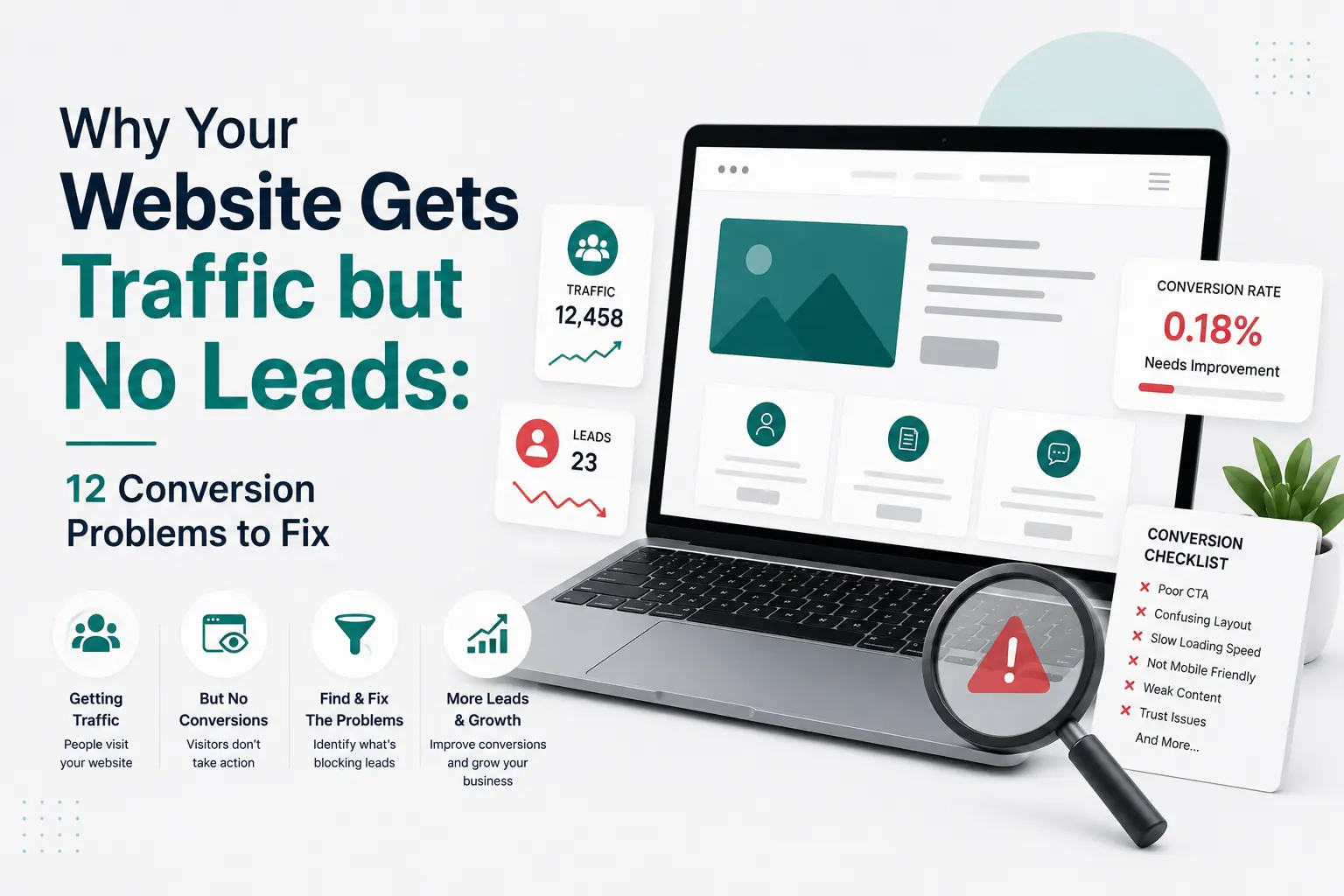
Your website may receive visitors from Google, social media, paid advertising, referrals and direct searches without generating enough telephone calls, messages, form submissions, appointments or sales. This does not always mean the website needs more traffic.
When a website gets traffic but no leads, the problem is usually found within traffic quality, search intent, page messaging, offer clarity, trust, usability, conversion tracking or customer follow-up.
A page can rank for several keywords and still attract people who are only looking for information. A Google or Meta advertising campaign can generate clicks while sending visitors to a page that does not match the advertisement. A professionally designed website can still underperform when visitors cannot understand the offer, verify the business or identify the correct next action.
Conversion problems can also continue after a visitor submits an enquiry. Leads may not receive an immediate acknowledgement, enquiries may not be assigned to the correct person, telephone calls may not be recorded and sales teams may not know which campaign generated each opportunity.
This guide explains why business websites receive traffic without generating enquiries, how to identify where potential customers are being lost and how SEO, landing pages, paid advertising, analytics, CRM and marketing automation can work together as one measurable lead-generation system.
Why Does a Website Get Traffic but No Leads?
A website can receive traffic without generating leads when visitors do not have the right intent, cannot understand the offer, do not trust the business, experience usability problems or cannot find a clear and relevant conversion path.
Website traffic measures visits. Lead generation measures whether suitable visitors complete an action that creates a genuine business opportunity. These are related measurements, but they are not the same outcome.
A website with fewer high-intent visitors can generate more qualified enquiries than a website receiving thousands of irrelevant visits. Traffic quality, page relevance and customer readiness can therefore matter more than the total number of sessions shown in an analytics platform.
Businesses should examine the complete customer journey rather than assuming that every conversion problem can be solved by publishing more content or spending more money on advertisements.
The journey normally includes the search term, advertisement or social post that introduced the visitor, the landing page the visitor entered, the information reviewed, the call to action selected, the enquiry process and the follow-up received after contact.
If any important part of this journey is unclear, slow, inconsistent or difficult to trust, potential customers may leave without contacting the business.
Key Takeaways
- Website traffic is not the same as qualified demand, enquiries or sales opportunities.
- A website can attract informational visitors who are not ready to contact or purchase from a business.
- Search intent should match the purpose, message and call to action of the landing page.
- A clear value proposition helps visitors understand what the business provides, who it helps and why they should continue.
- Each important landing page should have one clearly prioritised conversion objective.
- Advertisements and landing pages should communicate a consistent offer, audience and customer expectation.
- Reviews, case studies, contact information, business details and transparent claims can reduce customer uncertainty.
- Mobile usability, page speed and form accessibility can directly affect whether visitors complete an enquiry.
- Conversion tracking should measure meaningful actions rather than counting every button click as a lead.
- Google Ads, Meta Ads, SEO and social media should use appropriate landing pages instead of directing every visitor to the homepage.
- A CRM can record lead sources, assign enquiries and show how opportunities progress through the sales process.
- Automated acknowledgements can improve response consistency, but important enquiries still require human communication.
- Remarketing can reconnect with suitable visitors who need additional information before making a decision.
- Conversion optimisation should improve customer clarity and usability rather than rely on misleading urgency or pressure.
- Qualified leads and business outcomes matter more than traffic growth alone.
Which Website Problems Prevent Visitors from Becoming Leads?
Visitors are less likely to become leads when a website fails to connect their original question or need with a clear, credible and convenient next action.
A conversion problem does not always have one cause. Several smaller issues can combine to reduce performance. A page may load slowly on mobile, provide an unclear headline, contain limited proof and require visitors to complete a long form. Each issue adds friction to the customer journey.
Unqualified Traffic
The website attracts visitors who are researching a topic but do not need the service, location, price range or solution offered by the business.
Unclear Value Proposition
Visitors cannot quickly understand what the business provides, which problem it solves or why the offer is relevant to them.
Weak Conversion Path
The page contains several competing actions or does not make the most important next step clear.
Insufficient Trust
The website lacks genuine reviews, case studies, team information, business details, evidence or transparent service explanations.
Poor Mobile Experience
Buttons, forms, menus, text or page sections are difficult to use on smaller screens.
Incomplete Tracking
The business cannot determine which pages, keywords, advertisements or channels produced meaningful enquiries.
1. The Website Attracts the Wrong Search Intent
Search intent describes what a person is trying to achieve when entering a query. A person may want a definition, instructions, a comparison, a local provider, a price estimate or an immediate service.
An informational article may attract substantial traffic without generating immediate enquiries because the visitor is still learning. This does not make the article unsuccessful, but the page should not be evaluated using the same expectations as a service or campaign landing page.
Businesses should separate keywords according to intent:
- Informational questions
- Problem-aware searches
- Service comparison searches
- Location-based searches
- Provider-selection searches
- Pricing and cost searches
- Appointment or consultation searches
- Purchase-ready searches
An informational page can introduce relevant services naturally, provide supporting resources and direct qualified visitors towards a suitable service page. It should not be forced to behave like an aggressive sales page.
2. The Headline Does Not Explain the Offer
The first visible section should help the visitor understand the subject of the page and whether it is relevant to their situation.
A clear opening can communicate:
- The product or service being offered
- The type of customer the business helps
- The problem or outcome being addressed
- The location or service area when relevant
- The main action available to the visitor
General statements such as “transforming the future” or “unlocking excellence” may sound positive but provide limited practical information. The visitor should not need to search through several sections to discover what the company actually does.
3. The Website Promotes Too Many Services at Once
A homepage may introduce several services because it represents the complete organisation. However, a campaign landing page should normally focus on one main audience, problem, offer and conversion action.
When a page gives equal priority to website development, SEO, social media, advertising, branding, video production and automation, a visitor looking for one specific service may struggle to determine where to begin.
Separate service and landing pages make it possible to align the message with the visitor’s original need while still presenting related services where they add genuine value.
4. The Call to Action Is Unclear or Inappropriate
A call to action should explain what the visitor can do next. Examples may include requesting a proposal, booking a consultation, asking a question, obtaining a quotation, viewing a demonstration or starting an application.
The correct action depends on the level of customer commitment. A person reading an early-stage educational guide may not be ready to sign a contract, but may be willing to view a related service, check a case study or request an assessment.
A website should avoid displaying several equally prominent calls to action that send visitors in unrelated directions.
5. Enquiry Forms Create Unnecessary Friction
Forms should request the information needed to understand, route and respond to an enquiry. Requesting excessive information before establishing trust can reduce form completion.
Common form problems include:
- Too many mandatory fields
- Unclear field labels
- Poor mobile formatting
- Forms that remove entered information after an error
- Unclear submission confirmation
- No expected response time
- No explanation of how information will be used
- Technical errors that prevent submission
- Forms that cannot be completed using a keyboard
- Calls to action that do not explain what happens next
Lead quality should not be protected only by making the form longer. Landing-page messaging, qualifying questions and appropriate follow-up can help the business identify suitable prospects without creating an unnecessarily difficult first interaction.
6. The Website Does Not Provide Enough Trust
Potential customers may hesitate when a website makes important claims without evidence. Trust becomes particularly important for high-value services, long-term contracts and decisions involving business operations.
Useful trust signals can include:
- Accurate business name and contact information
- Clear explanations of services and processes
- Genuine customer reviews
- Approved testimonials
- Relevant case studies
- Team or contributor information
- Portfolio examples
- Industry experience
- Transparent limitations
- Privacy and business policies
Trust signals should be genuine and relevant. Businesses should not create fictional testimonials, present unverified numbers or imply guaranteed results.
7. The Mobile Experience Is Difficult to Use
A website can appear professional on a large desktop screen while creating serious problems on a mobile device. Text may become difficult to read, buttons may overlap, forms may extend beyond the screen and fixed elements may hide important content.
Mobile reviews should examine:
- Page loading behaviour
- Navigation and menu accessibility
- Text size and spacing
- Button size and separation
- Form completion
- Telephone and messaging links
- Image scaling
- Pop-ups and overlays
- Payment or booking processes
- Confirmation messages
8. The Advertisement and Landing Page Do Not Match
A visitor who clicks an advertisement expects the landing page to continue the same subject, offer and customer expectation.
Message mismatch can occur when:
- The advertisement promotes one service but opens a general homepage.
- The advertisement mentions a location that is not discussed on the page.
- The creative presents an offer that cannot be found after the click.
- The call to action changes between the advertisement and the website.
- The landing page targets a different customer group.
- Important conditions are hidden or unclear.
A relevant landing page confirms that the visitor has reached the correct destination and makes the next action easy to understand.
9. The Website Does Not Address Customer Objections
Visitors may need additional information before contacting the business. Common concerns involve cost, suitability, process, timeline, location, support, implementation and expected responsibilities.
A strong page should address the questions that genuinely affect customer decisions. This may involve FAQs, process explanations, service scope, case examples and clear next steps.
10. The Website Does Not Differentiate the Business
Potential customers may compare several businesses before making contact. If every website uses the same promises, stock phrases and service descriptions, there may be no clear reason to choose one organisation over another.
Differentiation can come from:
- A clearly defined customer group
- A specialised process
- Relevant experience
- Connected service delivery
- Transparent communication
- Genuine case examples
- Operational capabilities
- Customer support arrangements
- Original insights
- A clear strategic position
11. Conversion Tracking Is Missing or Incorrect
A business cannot improve website performance reliably when important customer actions are not measured or when every minor interaction is reported as a conversion.
Conversion tracking may include:
- Completed enquiry forms
- Telephone calls
- Appointment bookings
- Quotation requests
- Qualified messaging conversations
- Account registrations
- Completed purchases
- Applications
- Proposal requests
- CRM-qualified opportunities
Button clicks alone do not always represent confirmed leads. Tracking should distinguish between someone opening a form and successfully submitting it.
12. Leads Do Not Receive Effective Follow-Up
Website optimisation does not end when a person submits a form. Enquiries can be lost when nobody is responsible for responding, customer details are incomplete or the lead is not recorded in a shared system.
A lead-management process should define:
- Who receives each type of enquiry
- How quickly the lead should be acknowledged
- Which information should be recorded
- How lead quality is evaluated
- When follow-up should occur
- How telephone calls and messages are documented
- When an opportunity moves to another CRM stage
- How inactive leads are reviewed
- How consent and opt-out requests are handled
- How closed opportunities are attributed to their source
A website conversion problem may begin before the visitor reaches the page and continue after the visitor submits an enquiry.
How Can Businesses Diagnose Website Conversion Problems?
Businesses can diagnose conversion problems by reviewing traffic sources, landing pages, search intent, user behaviour, form functionality, conversion events, lead quality and sales follow-up as one connected system.
No individual metric provides a complete explanation. A high bounce rate does not always mean a page is poor, and a long visit does not always indicate purchase intent. Measurements should be interpreted according to the purpose of the page and the action expected from the visitor.
Traffic Source Review
Identify whether visitors arrived through organic search, paid campaigns, social media, referrals, direct navigation or another source.
Landing-Page Review
Examine which pages visitors entered and whether those pages matched the original keyword, advertisement or referral context.
Behaviour Review
Review navigation paths, important interactions, form usage and potential abandonment points without exposing personal information.
Technical Review
Test page speed, mobile usability, forms, call links, analytics tags, consent settings and confirmation processes.
Lead-Quality Review
Determine whether enquiries match the service, location, budget, timing and decision criteria of the business.
Sales-Process Review
Examine response times, lead assignments, follow-up completion and progression through the sales pipeline.
Review Traffic by Source and Landing Page
The first question is not simply how much traffic the website receives. The business needs to understand where visitors come from and which page introduces them to the website.
Traffic should be reviewed according to:
- Source and medium
- Campaign
- Keyword or search term where available
- Landing page
- Device category
- Geographic relevance
- New and returning visitors
- Meaningful conversion actions
- Lead quality
- Revenue or opportunity contribution where measurable
A page receiving significant international traffic may not help a business serving only customers in Nepal. Similarly, a campaign can attract clicks through broad or irrelevant targeting without creating suitable demand.
Compare Search Queries with Page Intent
Search performance information can show the questions and phrases associated with organic visibility. Paid advertising platforms can provide search-term information for applicable campaign types.
Businesses should look for patterns such as:
- Informational searches reaching commercial pages
- Employment searches reaching service pages
- Free-resource searches reaching paid offers
- Traffic from unsupported locations
- Queries for services the business does not provide
- Unrelated meanings of an ambiguous keyword
- Competitor or research queries with limited purchase intent
This information can guide content improvements, keyword targeting, negative keywords, internal links and dedicated landing pages.
Test Critical Conversion Actions Manually
Analytics cannot compensate for a form that does not work. Every important conversion process should be tested on multiple devices and browsers.
A manual test should confirm:
- The call-to-action button is visible and functional.
- The form accepts valid information.
- Validation messages are clear.
- The form can be completed on mobile.
- The submission reaches the correct recipient.
- The lead is recorded in the intended system.
- A confirmation message is shown.
- The customer receives an acknowledgement where appropriate.
- The correct conversion event is recorded.
- Duplicate or test leads can be identified.
Separate Micro-Conversions from Actual Leads
Viewing a service page, watching a video or clicking a button can indicate interest, but these actions should not automatically be reported as completed leads.
A measurement structure can distinguish:
- Engagement events: Relevant page views, video engagement and content interactions.
- Intent events: Opening a form, viewing contact information or starting a booking process.
- Lead events: Completed forms, connected calls, confirmed bookings and qualified messages.
- Sales events: Qualified opportunities, proposals, purchases and completed contracts where measurable.
Review Lead Quality with the Sales Team
Marketing analytics may show that a campaign generated enquiries, while the sales team reports that the enquiries were irrelevant or unreachable. Both perspectives are required.
Lead-quality feedback can identify:
- Unsupported locations
- Incorrect service expectations
- Unrealistic budgets
- Duplicate enquiries
- Spam
- Job applications
- Supplier enquiries
- Customers requiring a different service
- Suitable prospects needing longer follow-up
Marketing teams can use this information to improve audience targeting, keyword selection, page messaging and qualifying questions.
Prioritise Problems According to Impact
A business should normally fix critical technical and customer-journey problems before making small visual changes.
A practical priority order may include:
- Broken forms, calls, bookings or checkout processes
- Incorrect conversion tracking
- Irrelevant traffic and targeting
- Advertisement and landing-page mismatch
- Unclear offer and calls to action
- Mobile usability and speed problems
- Missing trust and decision information
- Lead-routing and follow-up failures
- Content and design improvements
- Controlled conversion tests
Conversion optimisation begins with accurate diagnosis. Changing colours, headings or buttons without identifying the actual problem can produce activity without meaningful improvement.
How Should SEO, Landing Pages, Paid Ads and CRM Work Together?
SEO, landing pages, paid advertising, analytics and CRM should share a consistent understanding of the target customer, offer, conversion action and lead-management process.
A disconnected marketing system creates gaps between customer discovery and business follow-up. SEO may attract traffic to an educational article while paid advertisements open the homepage, forms send emails to different employees and the CRM records no reliable lead source.
A connected system assigns each channel a clear role.
SEO and Search Visibility
SEO helps suitable customers discover relevant service pages, location pages, comparisons, guides and decision-supporting resources.
Landing Pages
Landing pages continue the visitor’s original intent through a focused message, relevant evidence and a clear conversion action.
Google Ads
Google Ads can capture existing demand when people actively search for applicable products, services or providers.
Meta Ads
Facebook and Instagram campaigns can support discovery, education, retargeting, lead generation and offer distribution.
Analytics and Attribution
Analytics can connect traffic sources and landing pages with important customer actions and confirmed conversion events.
CRM and Automation
A CRM can record lead information, source, ownership, follow-up activity and movement through the sales pipeline.
Use SEO Pages According to Customer Intent
An effective SEO structure can include resources for different stages of customer research:
- Educational guides for early information needs
- Problem-focused resources for developing demand
- Comparison pages for evaluation
- Service pages for commercial searches
- Location pages for genuine service areas
- Case studies for trust and provider evaluation
- FAQs for important customer concerns
- Contact and proposal pages for conversion
Internal links should help visitors move from useful information towards the relevant service or next action without forcing every article to compete for the same commercial keyword.
Create Dedicated Landing Pages for Important Campaigns
Sending every campaign to the homepage limits message relevance. A dedicated landing page can align the headline, service explanation, evidence and call to action with the advertisement or audience.
A campaign landing page may include:
- A message that continues the advertisement
- A clear explanation of the offer
- The intended customer or use case
- Relevant benefits and limitations
- Genuine proof
- A focused enquiry process
- Frequently asked questions
- Accurate business information
- Privacy information
- A measurable confirmation process
Use Google Ads to Capture Relevant Existing Demand
Search advertising can reach people who are actively looking for a product, service or provider. Performance depends on selecting suitable keywords, controlling search terms and connecting advertisements to relevant landing pages.
Google Ads reviews should examine:
- Search terms
- Keyword intent
- Location targeting
- Negative keywords
- Advertisement relevance
- Landing-page relevance
- Conversion actions
- Budget allocation
- Lead quality
- Sales outcomes where measurable
Use Meta Ads to Create and Develop Demand
Facebook and Instagram campaigns can introduce products and services to suitable audiences, educate potential customers and reconnect with people who previously interacted with the business.
Meta campaign performance can weaken when businesses select an objective that does not match the desired outcome, depend on one creative, use broad messages or fail to follow up with generated leads.
Creative and landing-page tests should maintain consistent claims and customer expectations.
Connect Conversion Tracking with CRM Data
Website analytics can show that an enquiry occurred. CRM data can show whether the enquiry was contacted, qualified, proposed and converted.
A connected lead record may include:
- Lead name and contact information
- Date and time of enquiry
- Original channel
- Campaign information
- Landing page
- Service requested
- Assigned team member
- Qualification status
- Follow-up activity
- Sales-stage progression
Customer information should be collected, stored and used responsibly. Access should be limited to authorised people, and consent or opt-out requirements should be respected.
Use Automation Without Removing Accountability
Marketing automation can support acknowledgement, lead assignment, reminders, appointment communication and approved follow-up sequences.
Automation can help with:
- Immediate enquiry acknowledgement
- CRM record creation
- Lead assignment
- Internal notifications
- Appointment reminders
- Follow-up reminders
- Approved educational sequences
- Status updates
- Review requests after suitable customer interactions
- Reporting and pipeline visibility
Automation should not be used to make unsupported promises, send uncontrolled messages or replace human judgement in sensitive customer situations.
A high-performing website is not an isolated design project. It is the central point connecting customer intent, marketing channels, evidence, conversion tracking and sales follow-up.
What Should a High-Converting Business Website Include?
A high-converting website should communicate a relevant offer clearly, establish genuine trust, reduce unnecessary friction and provide an accessible next action for suitable customers.
Conversion optimisation should help visitors make informed decisions. It should not depend on false scarcity, misleading countdown timers, hidden conditions or unsupported performance claims.
Clear Positioning
Explain what the business provides, who it helps and which customer problem or objective the service addresses.
Relevant Evidence
Use genuine reviews, portfolio examples, case studies, process information and verifiable business details.
Focused Conversion
Prioritise the most appropriate next action while providing reasonable alternatives where required.
Accessible Experience
Make important content, navigation, forms and interactive elements usable across browsers, devices and input methods.
Accurate Measurement
Track meaningful actions and connect online conversion information with lead quality and sales outcomes.
Reliable Follow-Up
Record enquiries, assign responsibility and maintain timely communication throughout the customer journey.
Clear Page Purpose
Every important page should have an identifiable purpose. A blog may educate, a case study may build trust, a service page may support evaluation and a landing page may generate a specific enquiry.
Page purpose affects the level of detail, call to action and performance measurement.
Customer-Focused Value Proposition
The page should explain the service in terms the intended customer can understand. Technical details may be important, but they should support rather than replace the main customer value.
A useful value proposition can clarify:
- The service or product
- The intended customer
- The problem being addressed
- The main business value
- The delivery approach
- The relevant location
- The appropriate next action
Original and Relevant Proof
Businesses should select evidence that supports the claim being made. A general testimonial may build confidence, while a detailed case study can explain the challenge, work completed and measured outcome.
Case studies should avoid exposing confidential information or presenting correlation as guaranteed causation.
Useful Service Information
A visitor should be able to understand what the service includes and whether it is suitable for their needs.
Depending on the service, useful information may include:
- Service scope
- Customer responsibilities
- Delivery process
- Indicative timelines
- Relevant technologies or platforms
- Support arrangements
- Important exclusions
- Pricing approach
- Proposal or assessment process
- Frequently asked questions
One Clearly Prioritised Conversion Action
The main conversion action should be easy to identify throughout the page. Button language should describe what will happen instead of relying only on general words such as “submit.”
Suitable alternatives can include telephone, messaging or email where those options reflect how customers genuinely communicate with the business.
Short and Functional Enquiry Process
The enquiry process should collect enough information to start a useful conversation without creating excessive friction. Important forms should be tested regularly and monitored for delivery failures.
Fast and Usable Mobile Experience
Images, scripts, videos, fonts and third-party tools should be reviewed because they can affect loading and interaction. Performance improvements should preserve important content, functionality and measurement.
Customer Questions and Direct Answers
FAQs can reduce uncertainty when they address genuine questions. They should not duplicate every paragraph or be added only to increase the number of keywords on the page.
Transparent Business Information
Customers should be able to identify the organisation responsible for the website and understand how to contact it. Important policies should be accessible where relevant.
Connected Analytics and Follow-Up
The website should record meaningful conversion events and pass appropriate lead information to the responsible system or person. Reporting should connect traffic and enquiries with lead quality whenever reliable data is available.
A high-converting website makes a suitable customer’s decision easier. It does not pressure an unsuitable visitor into submitting an enquiry.
How Can Gripas Marketing Turn Website Traffic into Qualified Leads?
Gripas Marketing connects SEO, paid advertising, conversion-focused websites, landing pages, analytics, CRM and marketing automation into one measurable digital growth system.
Increasing website traffic is only one part of digital growth. The complete system should attract suitable visitors, communicate the offer clearly, create a relevant conversion path, capture accurate lead information and support consistent follow-up.
Gripas Marketing reviews the customer journey from the first keyword, advertisement or social interaction through to the website enquiry and CRM pipeline.
Website Conversion Review
Review page purpose, positioning, calls to action, forms, trust signals, mobile usability and potential customer friction.
SEO and Search Intent
Align content, service pages and internal links with genuine informational, commercial and location-based searches.
Landing Page Development
Create focused landing pages for specific services, audiences, campaigns and conversion objectives.
Google and Meta Ads
Connect campaign objectives, audiences, keywords, creative messages, landing pages and conversion tracking.
Analytics and Measurement
Configure meaningful events and reporting for forms, calls, appointments, purchases and other applicable actions.
CRM and Lead Routing
Record lead sources, assign enquiries, manage sales stages and improve visibility across the follow-up process.
Marketing Automation
Develop controlled workflows for acknowledgements, notifications, appointment reminders and approved follow-up.
Continuous Optimisation
Use qualified lead information and performance data to identify problems, test improvements and refine the customer journey.
What a Website Lead-Generation Review May Include
- Business objectives and target customer review
- Website traffic and landing-page review
- Organic search visibility review
- Paid advertising traffic review
- Search-intent assessment
- Service-page and landing-page evaluation
- Value proposition and message review
- Call-to-action review
- Form and booking-process testing
- Mobile usability assessment
- Trust-signal and content review
- Conversion-tracking assessment
- Lead-source and attribution review
- CRM and lead-routing review
- Customer follow-up assessment
- Prioritised optimisation recommendations
A Connected Approach to Digital Growth
A potential customer may first discover a Gripas Marketing client through Google, visit a service page, review social media, return through a remarketing advertisement and submit a proposal request several days later.
Evaluating only the final click can hide the contribution of earlier interactions. Gripas Marketing evaluates available customer-journey information while avoiding unsupported claims about attribution.
The final strategy depends on the organisation’s market, offer, website, existing traffic, campaign activity, internal resources, customer decision process and lead-management capacity.
Turn More of Your Website Traffic into Qualified Enquiries
Gripas Marketing can review why your website receives traffic without generating sufficient enquiries and identify whether the problem involves targeting, search intent, landing pages, messaging, trust, usability, tracking or follow-up.
The recommended scope may include website improvements, landing page development, SEO, Google Ads, Meta Ads, analytics, CRM integration and marketing automation.
Frequently Asked Questions
Why is my website getting traffic but no leads?
Your website may attract visitors with the wrong intent or fail to communicate a clear, trustworthy and relevant offer. Conversion problems can also involve mobile usability, forms, tracking, landing-page relevance and delayed customer follow-up.
Does more website traffic automatically generate more leads?
More traffic does not automatically generate more leads because visitors can have different needs, locations and levels of purchase intent. Qualified traffic connected to a relevant page and clear conversion path is generally more valuable than high volumes of unrelated visits.
How can a business increase website enquiries?
A business can improve enquiries by aligning traffic with customer intent, clarifying its offer, adding genuine proof and simplifying the conversion process. Accurate tracking and consistent lead follow-up are also necessary for understanding whether website improvements create business value.
Should advertisements send visitors to the homepage?
A homepage can be suitable for broad brand campaigns, but service and lead-generation campaigns often benefit from a focused landing page. The destination should continue the advertisement’s message, audience, offer and expected customer action.
How does Gripas Marketing improve website lead generation?
Gripas Marketing connects website conversion, SEO, landing pages, paid advertising, analytics, CRM and marketing automation. The recommended approach is based on the business objective, customer journey, existing performance and available operational resources.
Related Gripas Marketing Resources
- Explore Gripas Marketing Services
- Read the Digital Marketing in Nepal Guide
- Read the Digital Marketing Budget and Packages Guide
- Read the Local SEO in Nepal Guide
- Read the AI Search and AI Overviews Guide
- Explore AI Automation Services in Nepal
- Explore Marketing Automation in Nepal
- View the Gripas Marketing Portfolio
- Read the Gripas Marketing Blog
- Request a Custom Proposal
- Contact Gripas Marketing
Editorial Sources and Review Notes
- Google Search Central: Creating Helpful, Reliable, People-First Content
- https://developers.google.com/search/docs/fundamentals/seo-starter-guideGoogle Search Central: SEO Starter Guide
- https://support.google.com/analytics/answer/9322688Google Analytics: Events and User Interactions
- https://support.google.com/google-ads/answer/6095821Google Ads: About Conversion Tracking
- https://web.dev/articles/vitalsWeb.dev: Core Web Vitals
- https://www.w3.org/WAI/standards-guidelines/wcag/W3C: Web Content Accessibility Guidelines