
AI SEO Services
Improve your visibility across traditional search, AI Overviews, Microsoft Copilot and generative search experiences with an integrated SEO, AEO and GEO strategy.

AI SEO, AEO & GEO
Build Visibility Across Traditional and AI-Powered Search
AI SEO is the process of improving how a brand and its content are discovered, understood and referenced across traditional search results and AI-powered search experiences. It combines established SEO practices with Answer Engine Optimization and Generative Engine Optimization.
AEO focuses on making content easier for search and answer systems to retrieve when responding to specific questions. GEO focuses on strengthening a website’s eligibility to be used as a grounding source or citation in generative answers. Both depend on technically accessible pages, clear content, reliable information, entity consistency and wider brand authority.
Gripas Marketing combines SEO, AEO and GEO into one coordinated strategy. We improve technical accessibility, search intent coverage, concise answer sections, topic structure, internal links, structured data, entity clarity and evidence-based authority signals.
Google states that no special optimisation is required for inclusion in AI Overviews or AI Mode. The same foundational SEO practices remain relevant because these AI features use Google’s Search index and core ranking and quality systems.
Microsoft similarly recommends content that is fresh, authoritative, structured and semantically clear. Crawlability, metadata, internal links and backlinks remain essential foundations for content discovery and potential selection in AI-generated answers

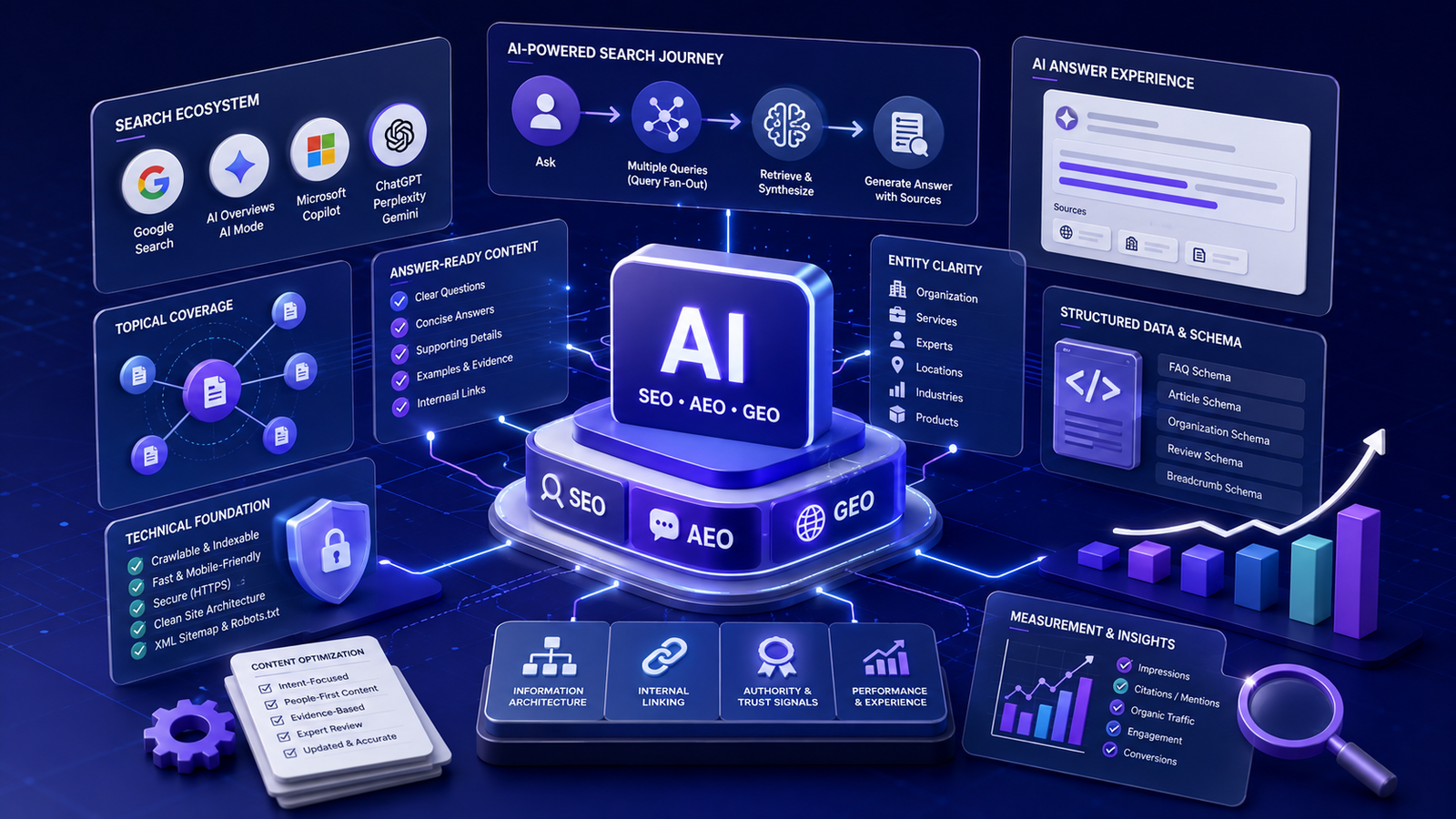
Make Your Content Easier to Discover, Understand and Reference
Search behaviour is expanding beyond traditional lists of links. People now use AI Overviews, AI Mode, Microsoft Copilot and other generative experiences to ask detailed questions, compare options, research services and explore complex topics.
These systems can retrieve information from multiple webpages and assemble relevant sections into a generated answer. A page may therefore need to satisfy both the broader search intent and the specific subquestions generated during retrieval.
Google explains that its generative search features can use retrieval-augmented generation and query fan-out. Query fan-out allows the system to issue multiple related searches across subtopics and data sources before generating a response with supporting links.
This means an effective AI SEO strategy should not focus only on one exact keyword. The website needs clear topical coverage, answer-ready sections, strong relationships between pages and reliable information that can satisfy multiple related questions.
Gripas Marketing begins by reviewing your existing organic search foundation. We assess whether priority pages are crawlable and indexable, whether each page has a clear purpose and whether the content addresses the questions customers ask throughout the buying journey.
We then examine how clearly the website communicates important entities. These may include the business, services, locations, team expertise, products, industries, partners and relevant technical concepts. Consistent entity information helps search and retrieval systems connect facts across multiple pages and trusted external sources.
Content is reorganised into clear and independently understandable sections. Important questions receive concise answers followed by supporting explanations, evidence, examples and relevant internal links. This structure serves readers first while also helping retrieval systems identify useful passages.
Where appropriate, we strengthen claims with first-party evidence, cited sources, qualified expert review, transparent authorship and clear update information. Unsupported statements, fabricated statistics and vague claims are removed or rewritten.
The result is a stronger information architecture that supports traditional organic search, featured answers, AI-generated search experiences and customer decision-making without relying on speculative optimisation tactics.
3 Connected Disciplines
SEO, AEO and GEO
Traditional discovery, direct-answer clarity and generative search retrievability work together.
Full Content Review
Technical, Semantic and Evidential
Pages are assessed for accessibility, structure, entities, topic coverage, sources and authority.
No Guaranteed Citations
Evidence-Led Optimization
Performance is evaluated through available visibility, citation, traffic, engagement and conversion indicators.
Key Benefits of AI SEO
- Strengthen visibility across traditional and AI-powered search experiences.
- Connect SEO, AEO and GEO within one coordinated strategy.
- Improve the technical accessibility of important website content.
- Give every priority page a clear topic and search purpose.
- Answer customer questions through concise and useful content sections.
- Develop deeper coverage of related questions and subtopics.
- Make important passages easier to understand independently.
- Improve consistency across brand, service and expert entities.
- Strengthen claims through evidence, attribution and reliable sources.
- Create logical relationships between service pages and supporting resources.
- Improve content freshness through scheduled reviews and updates.
- Add accurate structured data where relevant and supported.
- Coordinate on-page content with off-page authority development.
- Monitor AI citation activity where supported reporting is available.
- Improve the journey from AI-assisted research to website engagement.
- Avoid speculative tactics and unsupported promises.
- Build a repeatable content framework for future AI search developments.
- Receive documented priorities and transparent performance reporting.
Clear process,focused execution, and growth that feels organized.
How Our AI SEO Process Works
Our AI SEO process combines foundational SEO, Answer Engine Optimization and Generative Engine Optimization. Every stage is designed to improve technical accessibility, answer clarity, entity consistency and content retrievability.
-
01
Search and AI Visibility Audit
We review organic visibility, technical access, priority pages, content structure, entities, citations and available AI search performance indicators.
-
02
Query and Topic Mapping
We map customer questions, supporting searches, comparisons, definitions and related subtopics across the most appropriate website pages.
-
03
Answer and Content Optimization
We improve headings, direct answers, supporting explanations, page summaries and independently understandable content sections.
-
04
Entity and Authority Development
We strengthen entity consistency, authorship, evidence, source attribution, internal links and relevant external authority signals.
-
05
Monitor and Refine
We monitor available search visibility, citations, cited pages, traffic, engagement and conversions, then document the next priorities.
FAQs
Questions Businesses Ask About AI SEO, AEO and GEO
We believe clarity builds trust. Here are answers to the most common questions we get.
What is AI SEO?
AI SEO is the process of improving how a website and its content are discovered, understood and potentially referenced across traditional and AI-powered search experiences. It combines technical SEO, content optimisation, AEO, GEO, entity clarity and authority development.
What is Answer Engine Optimization?
Answer Engine Optimization helps search and answer systems retrieve clear responses to specific questions. AEO commonly involves direct answers, logical headings, definitions, supporting explanations, structured content and reliable information.
What is Generative Engine Optimization?
Generative Engine Optimization improves the clarity, credibility and retrievability of content that may be considered when generative systems create answers. GEO can include technical accessibility, topical coverage, entity consistency, evidence, references and external authority.
What is the difference between SEO, AEO and GEO?
SEO develops visibility across organic search. AEO makes specific answers easier to retrieve. GEO strengthens content for potential grounding or citation in generative answers. These disciplines overlap and should be managed as one connected search strategy.
Does Google require special AI SEO markup?
No. Google states that there are no additional technical requirements or special optimisations required to appear in AI Overviews or AI Mode. Foundational SEO best practices continue to apply.
Can AI SEO guarantee inclusion in Google AI Overviews?
No. No agency can guarantee inclusion, citation or placement within an AI Overview. Google’s systems determine when an AI Overview is useful and which supporting links are relevant.
What is retrieval-augmented generation?
Retrieval-augmented generation uses retrieved information to improve the reliability, relevance and freshness of a generated response. Google explains that generative features can retrieve relevant webpages from its Search index before producing an answer with supporting links.