


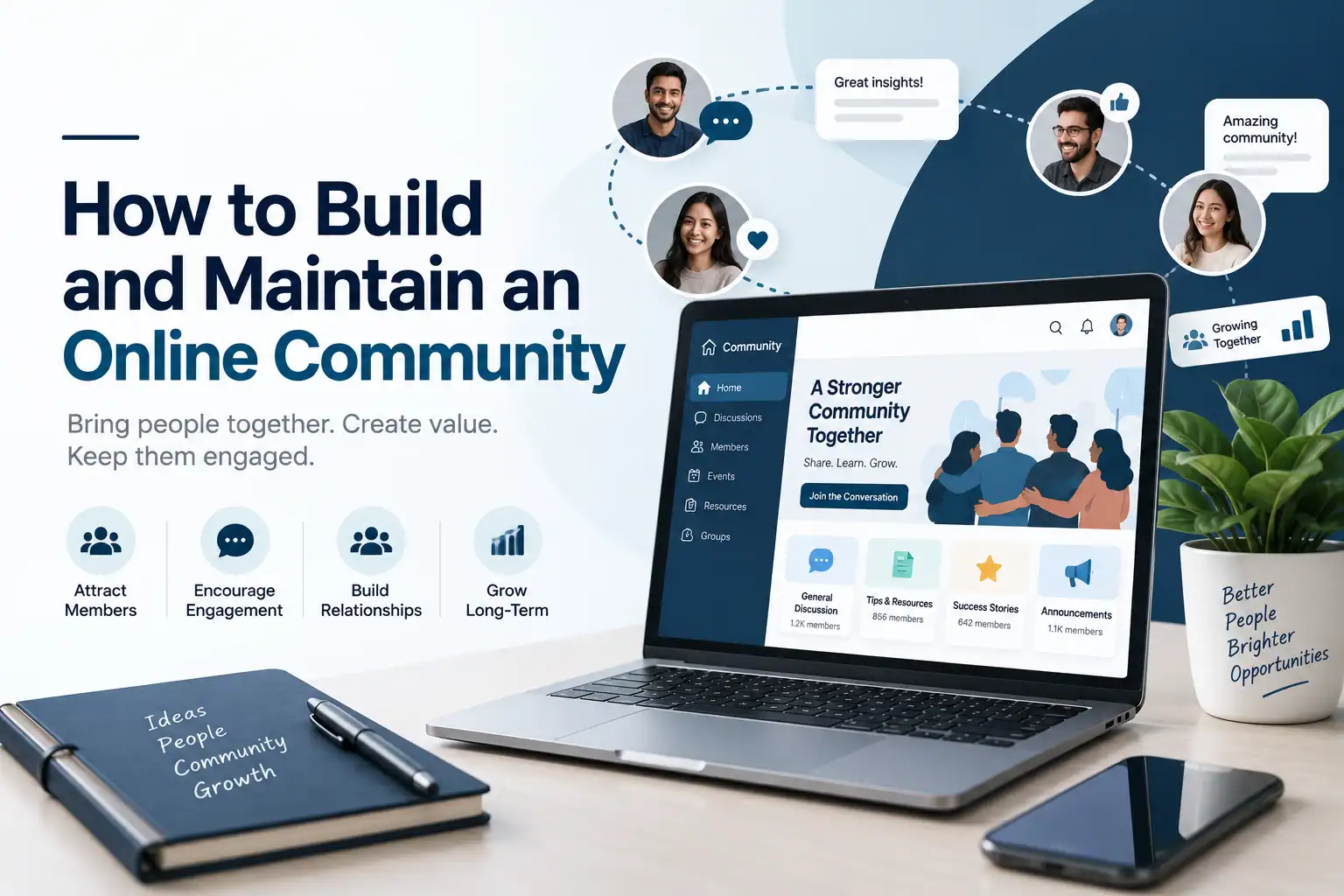
An online community can give customers, followers, professionals or people with a shared interest a place to ask questions, exchange experiences and build relationships around a meaningful purpose.
Building an online community is not the same as increasing a follower count. A community becomes valuable when members have a clear reason to return, participate and help one another.
Businesses often create a Facebook Group, LinkedIn Group, Discord server, WhatsApp community or private membership space and expect engagement to develop naturally. Activity may be strong during launch, then decline when discussions depend entirely on the administrator.
A sustainable community needs a defined purpose, suitable platform, useful onboarding, consistent participation, clear guidelines, responsible moderation and measurements connected to member value.
This guide explains how to build an online community, attract the right members, encourage useful participation, manage conflict, measure community health and maintain the group without turning every interaction into a sales message.
How Do You Build and Maintain a Successful Online Community?
Build a successful online community by defining who it serves, what members gain, what behaviour is expected and how participation will be supported after launch.
Choose the platform according to member behaviour, discussion needs, privacy expectations, moderation controls and the resources available to manage it. Do not choose a platform only because it is currently popular.
Start with a small group of relevant members, provide an organised onboarding experience and create repeatable participation formats such as questions, member introductions, expert sessions, challenges, resource exchanges and peer support.
Maintain the community through visible leadership, clear rules, fair moderation, member recognition, regular listening and a content rhythm that gives members room to contribute.
Measure active participation, returning contributors, response quality, unanswered questions, moderation issues, member retention and business contribution rather than relying only on total membership.
Key Takeaways
- A clear community purpose is more important than choosing a platform first.
- The community should solve a recurring member need rather than exist only to promote a business.
- Define ideal members, boundaries and success criteria before launching.
- Choose a platform based on member behaviour, content format, moderation and ownership needs.
- Start with a focused founding group instead of chasing a large inactive membership.
- Onboarding should show newcomers what to do, where to begin and how to participate.
- Community content should start conversations rather than simply distribute announcements.
- Member-to-member interaction is a stronger sign of community health than administrator-led activity alone.
- Written guidelines should explain acceptable behaviour, promotion, privacy and enforcement.
- Moderation should be consistent, proportionate and documented.
- Community managers should recognise useful contributions without creating artificial engagement.
- Brands should not turn every discussion into a sales opportunity.
- Growth should not outpace moderation, onboarding and member-support capacity.
- Measure active members, returning contributors, response quality and retention rather than total members alone.
- A community cannot guarantee sales, loyalty or organic reach, but it can strengthen relationships when managed responsibly.
What Is an Online Community?
An online community is a group of people who gather in a digital space around a shared purpose, challenge, identity, profession, product or interest.
A community differs from an audience. An audience mainly receives information from a creator or organisation. A community also creates relationships between members.
Brand Community
Connect customers and supporters around a brand, product category or shared experience.
Customer Community
Help users ask questions, exchange advice, discover features and support one another.
Professional Community
Bring practitioners together to discuss challenges, knowledge, opportunities and industry change.
Learning Community
Support students or members through discussions, resources, events and peer accountability.
Local Community
Connect people around a place, service area, event programme or local interest.
Membership Community
Provide private access, structured resources, networking or continuing support.
Community Is More Than Comments
A social media page can receive comments without becoming a community. Community begins when people recognise a shared purpose, understand how to participate and expect ongoing value from returning.
Signs of genuine community can include:
- Members answer one another’s questions
- People return without being reminded constantly
- Members use shared language or practices
- Useful contributors become recognisable
- Discussions continue beyond the original post
- Members recommend resources and connections
- The group develops knowledge that benefits newcomers
A large follower count may support distribution, but it does not prove that these relationships exist.
How Do You Define the Purpose of an Online Community?
Define the community by identifying who it is for, what recurring need it addresses, what members can do together and what the space will not become.
Meta’s community-management learning programme begins with mission, goals, success criteria and guidelines. This order matters because content and platform features cannot compensate for an unclear reason to participate.
Start with the Member’s Reason to Join
A brand may want loyalty, feedback, referrals or customer retention. Members are more likely to care about learning, support, access, recognition, connection or progress.
A useful community purpose should connect both sides without pretending they are identical.
Write a Community Purpose Statement
A purpose statement can follow this structure:
This community helps [specific members] achieve or understand [recurring outcome] by providing [distinct participation and value] within [clear boundaries].
For example, a community for small ecommerce owners may help members improve online-store operations through practical discussions, peer examples and expert sessions without allowing unsolicited service promotion.
Define What the Community Is Not
Boundaries reduce confusion. State whether the group is not a customer-support replacement, job board, promotional directory, political forum or general social chat.
Set Member and Business Outcomes Separately
Member outcomes may include faster learning, reliable answers, useful connections and recognition. Business outcomes may include product insight, customer retention, reputation, research and qualified demand.
If the business outcome consistently overrides member value, participation usually declines.
Which Platform Is Best for Building an Online Community?
The best community platform is the one members will use consistently and the organisation can moderate responsibly.
Platform choice should consider whether the community is public or private, whether conversations need to be searchable, which content formats matter, how member data is handled and whether the group may need to move later.
Facebook Groups
Suitable for broad consumer communities, local interests, events, peer discussion and familiar participation.
LinkedIn Groups
Suitable for professional, industry, alumni, recruitment and business-to-business communities.
WhatsApp Communities
Useful for timely updates and connected groups where members already rely on messaging.
Discord
Useful for organised real-time discussion, topic channels, creator groups, technology and interest communities.
Slack
Suitable for professional cohorts, private networks, programmes and collaboration-focused groups.
Owned Community Platform
Provides greater control over branding, structure and data but requires more setup, support and member adoption.
Questions to Ask Before Choosing
- Where do intended members already spend time?
- Do discussions need to be public, private or searchable?
- Will members share text, video, documents or live sessions?
- Which moderation controls are required?
- How will new members be approved?
- Can the organisation export important information?
- What data and privacy considerations apply?
- Can the management team sustain the platform?
- What happens if the platform changes its rules or features?
Do not launch identical communities on several platforms without a clear reason. Fragmented membership makes discussion harder to sustain and increases moderation work.
How Do You Launch an Online Community?
Launch an online community with a focused founding group, clear onboarding and enough initial activity to show members how the space should work.
1. Recruit Founding Members
Invite customers, colleagues, partners, students, professionals or advocates who genuinely match the purpose. Explain why they were invited and what influence they can have during the early stage.
2. Seed Useful Discussions
Prepare discussions that reveal member needs and make participation easy. Avoid filling the group with promotional links before members have a reason to contribute.
Useful launch prompts include:
- What brought you to this community?
- Which challenge are you working on now?
- What do you wish you had known earlier?
- Which resource has helped you recently?
- What topic should the community explore first?
3. Create a Welcome Journey
A new member should quickly understand the purpose, guidelines, current discussions and first action.
Onboarding can include:
- A welcome message
- A short description of the community
- Guidelines
- An introduction thread
- A starting resource
- Notification guidance
- A contact route for concerns
4. Set a Realistic Rhythm
Choose a publishing and event rhythm that the team can maintain. One strong weekly discussion may be more useful than daily posts that attract no response.
5. Learn Before Scaling
Observe which questions attract participation, where members become confused and which rules need clarification. Improve the experience before inviting a much larger audience.
How Do You Keep an Online Community Engaged?
Keep an online community engaged by creating useful reasons to participate, recognising member contributions and helping members connect with one another.
Engagement should not be manufactured through repetitive polls, tags or empty prompts. The goal is meaningful participation that helps members make progress, exchange knowledge or feel connected.
Create Repeatable Participation Formats
Weekly Questions
Invite members to share a practical experience, decision, challenge or recommendation.
Member Introductions
Help newcomers explain what they do, what they need and how they can contribute.
Expert Sessions
Use live discussions, interviews or written Q&A sessions around specific member concerns.
Challenges
Help members complete a relevant action over a defined period with peer accountability.
Member Spotlights
Recognise useful work, progress or expertise without turning recognition into a popularity contest.
Resource Exchanges
Invite members to contribute tools, examples, templates and lessons around a focused topic.
Ask Better Questions
Broad prompts such as “What do you think?” often provide too little direction. Better questions give members context and a manageable way to answer.
Compare these approaches:
- Weak: What is your biggest business challenge?
- Stronger: Which part of your customer follow-up process creates the most delay?
- Weak: Share your thoughts on marketing.
- Stronger: Which marketing channel created your most suitable enquiry this quarter, and why?
Respond Without Taking Over
A community manager should welcome participation, ask useful follow-up questions and connect members with relevant discussions. They should not answer every question so quickly that members have no space to help one another.
Recognise Contribution, Not Noise
Recognition should reward useful answers, thoughtful questions, reliable support and constructive disagreement. If attention goes mainly to frequent posters, quieter experts may stop contributing.
Create Paths for Deeper Involvement
Active members may become discussion hosts, event guests, mentors, moderators or advisory contributors. Responsibilities should be clear, voluntary and supported.
How Do You Create Community Guidelines and Moderate Fairly?
Community guidelines should explain acceptable behaviour, promotion, privacy, safety and enforcement in language members can understand.
Meta’s community-management training treats guidelines, moderation, personal connection and conflict management as core parts of sustaining a community. Platform rules also remain relevant. YouTube, for example, applies its Community Guidelines to videos, comments, posts, thumbnails and links.
Guidelines Should Cover
- Respectful participation
- Harassment and personal attacks
- Discrimination and hateful conduct
- Spam and repeated promotion
- Misleading information
- Privacy and confidential information
- Copyright and content ownership
- Relevant discussion boundaries
- Commercial posts and affiliate links
- Reporting concerns
- Enforcement and appeals
Use Proportionate Enforcement
Not every mistake requires removal. A useful moderation framework may include a clarification, reminder, warning, temporary restriction or removal depending on severity, intent and repetition.
Serious safety threats, harassment, fraud or unlawful material may require immediate action according to platform features, organisational policy and applicable requirements.
Document Difficult Decisions
Keep internal records of significant incidents, actions and reasons. Documentation helps moderators apply rules consistently and gives the organisation context if a decision is questioned later.
Protect Member Privacy
Do not assume that content shared in a private group can be reused publicly. Obtain appropriate permission before turning a discussion, testimonial, screenshot or member story into marketing material.
Prepare for Conflict
Disagreement can be useful when it remains relevant and respectful. Moderators should distinguish between a difficult opinion, a personal attack and a pattern of disruption.
What Content Should You Publish in an Online Community?
Community content should help members participate, learn, connect or contribute rather than simply receive brand announcements.
Use Four Content Roles
- Orient: Help members understand the community and find useful resources.
- Activate: Invite questions, stories, opinions or actions.
- Connect: Introduce members with shared needs or complementary knowledge.
- Recognise: Highlight helpful contributions, progress and lessons.
Build Around Member Decisions
Community content should respond to genuine needs. Review recurring questions, unresolved discussions, event feedback, search behaviour, support requests and member interviews.
Balance Administrator and Member Content
If every discussion begins with the administrator, the group may behave like a broadcast channel. Invite member-led questions, demonstrations, case discussions and resource contributions.
Avoid Constant Promotion
Commercial communities can still support sales, but trust weakens when every helpful discussion becomes a product pitch. Promotional posts should be relevant, clear and proportionate to the value the community receives.
How Do You Maintain an Online Community Over Time?
Maintain an online community by reviewing member needs, developing reliable leaders, improving systems and changing the programme when participation patterns shift.
Create an Operating Rhythm
- Daily moderation checks according to risk and activity
- Regular discussion prompts
- New-member welcomes
- Unanswered-question follow-up
- Monthly performance review
- Periodic member feedback
- Guideline and resource updates
- Moderator training and wellbeing checks
Prevent Founder Dependence
A community is fragile when one person holds every relationship, password and decision. Document processes, use role-based access and develop additional moderators or hosts.
Archive or Refresh Old Resources
Outdated pinned posts, broken links and duplicated resources make the community harder to use. Review important content and direct members to current answers.
Listen for Changing Needs
A community created around beginner questions may attract more advanced members later. The team may need separate events, channels or resource levels without fragmenting the group unnecessarily.
Know When to Reduce Activity
More activity is not always healthier. If members feel overwhelmed, reduce low-value announcements, repetitive tags or unnecessary notifications.
How Do You Measure Online Community Success?
Measure community success through participation quality, returning activity, useful responses, member retention and progress toward the community’s stated purpose.
Total membership is easy to report, but it can conceal inactivity. A smaller community with regular member-to-member support may be healthier than a large group where most posts receive no response.
Active Members
Track how many members participate meaningfully within a relevant period.
Returning Contributors
Measure whether members come back and contribute more than once.
Response Quality
Review whether questions receive accurate, useful and timely responses.
Member-to-Member Activity
Assess how often members support one another without administrator intervention.
Retention and Churn
Observe whether suitable members remain, leave, mute or become inactive.
Business Contribution
Connect the community carefully with research, retention, referrals, support or qualified demand.
Useful Community Metrics
- New members
- Activated new members
- Active members
- Returning contributors
- Posts and substantive comments
- Questions answered
- Median response time
- Member-to-member replies
- Event participation
- Resource use
- Reported incidents
- Member satisfaction
- Retention
Metrics should be interpreted in context. A support community may value resolution and response quality. A professional community may value recurring contributors and useful introductions. A customer community may value adoption, retention and product insight.
What Online Community-Building Mistakes Should You Avoid?
Most online communities struggle because they launch without a distinct purpose, rely on the administrator for every conversation or prioritise growth before member value.
Launching Before Defining the Purpose
A broad promise to “connect like-minded people” gives potential members little reason to choose one community over another.
Choosing a Platform Before Understanding Members
A feature-rich platform still fails if intended members find it inconvenient, unfamiliar or unsuitable for the conversations they need.
Inviting Everyone
Rapid growth can weaken relevance when new members do not share the purpose or understand the expected behaviour.
Publishing Without Facilitating
Posting content is not the same as managing a community. Managers need to welcome people, connect discussions, recognise contributions and address problems.
Over-Automating Relationships
Automation can support welcome messages, reminders and reporting. It should not imitate personal care or send intrusive messages that ignore member context.
Using Members as a Marketing List
People may join for knowledge or connection. Treating every member as a sales lead can damage trust and encourage valuable contributors to leave.
Ignoring Moderator Capacity
Growth creates more onboarding, questions, conflict and safety work. The community should not expand faster than its ability to manage these responsibilities.
Tracking Vanity Metrics
Member totals, reactions and post volume do not explain whether people receive useful answers or build lasting relationships.
How Can an Online Community Support Business Growth?
An online community can support business growth through trust, customer insight, education, retention, referrals and qualified demand when member value remains the priority.
Customer Insight
Recurring questions and discussions can reveal customer language, misconceptions, unmet needs and product opportunities. The business should not treat every comment as representative of the entire market.
Customer Education
A community can help members understand a product, service or field through peer examples, expert responses and organised resources.
Retention and Loyalty
Useful relationships may give customers another reason to remain connected. Community should not be used to hide product, support or service problems.
Referrals and Advocacy
Members may recommend a community or business when their experience is genuinely useful. Advocacy should develop through value rather than pressure or manufactured testimonials.
Qualified Commercial Opportunities
Some members may become customers after understanding the business and seeing its expertise. The organisation should create clear, optional routes to services without turning discussions into unsolicited sales outreach.
How Can Gripas Marketing Support Online Community Management?
Gripas Marketing helps brands plan, launch and manage online communities through strategy, content, moderation workflows, member engagement and performance reporting.
The recommended scope depends on the community purpose, member profile, platform, risk level, content requirements and internal resources. Not every organisation needs a fully outsourced community-management service.
Community Strategy
Define members, purpose, boundaries, outcomes, platform requirements and success criteria.
Launch Planning
Prepare founding-member outreach, onboarding, guidelines, initial discussions and operating processes.
Content and Engagement
Create discussion formats, member prompts, events, resources and recognition programmes.
Moderation Support
Develop escalation rules, moderation records, response guidance and role responsibilities.
Community Reporting
Track active participation, returning contributors, response quality, retention and community outcomes.
Connected Marketing
Connect community insights with social media, content, CRM and customer journeys where appropriate.
Build a Community People Have a Reason to Return To
If your group has members but little participation, or you are planning a new community and need a practical operating system, Gripas Marketing can help develop the strategy, content rhythm, onboarding and moderation process.
The objective is not to manufacture comments. It is to create a useful space that supports members and contributes responsibly to the organisation’s broader goals.
Frequently Asked Questions
How do you start an online community?
Start by defining the intended members, recurring need, shared purpose and participation boundaries. Choose a suitable platform, invite a focused founding group and provide clear onboarding, discussions and guidelines.
Which platform is best for an online community?
The best platform depends on member behaviour, discussion format, privacy, moderation, searchability and management capacity. Facebook, LinkedIn, WhatsApp, Discord, Slack and owned platforms serve different community needs.
How do you keep an online community active?
Create repeatable opportunities for members to ask questions, exchange knowledge, attend events and recognise one another. Community managers should facilitate member relationships rather than publish announcements only.
How often should a community manager post?
There is no universal posting frequency. Use a rhythm the team can sustain and adjust it according to member response, discussion quality and notification fatigue.
What should community guidelines include?
Guidelines should cover respectful behaviour, harassment, spam, promotion, privacy, copyright, discussion boundaries and enforcement. They should also explain how members can report a concern.
How do you moderate an online community?
Apply published rules consistently, document significant decisions and use proportionate actions based on severity and repetition. Serious safety, harassment or fraud concerns may require immediate removal or escalation.
How do you measure community engagement?
Measure active members, returning contributors, substantive responses, member-to-member interaction, response time and retention. Total membership and reactions alone do not show whether the community is useful.
Can an online community generate leads?
A useful community can create qualified commercial interest through trust, education and relationships. Brands should provide optional next steps and avoid treating every member interaction as a sales opportunity.
Should a business outsource community management?
Outsourcing can help when the business lacks strategy, content, moderation or reporting capacity. Internal subject knowledge and authority should remain involved, especially for sensitive customer or industry issues.
Does Gripas Marketing provide community management services?
Gripas Marketing can support community strategy, launch planning, content, engagement, moderation workflows and reporting. The recommended scope depends on the platform, member needs, risk level and internal resources.
Related Gripas Marketing Resources
Editorial Sources and Review Notes
- Meta Blueprint: Community Management Courses
- YouTube: Community Guidelines
- YouTube: Policies and Guidelines Tips
Platform features, policies and group-management controls change over time. Review the current rules of the selected platform before launching or changing moderation processes.
This article provides general community-management guidance. Organisations should obtain appropriate legal, privacy, safeguarding or industry advice when their communities involve sensitive information, children, health, finance or regulated activity.