


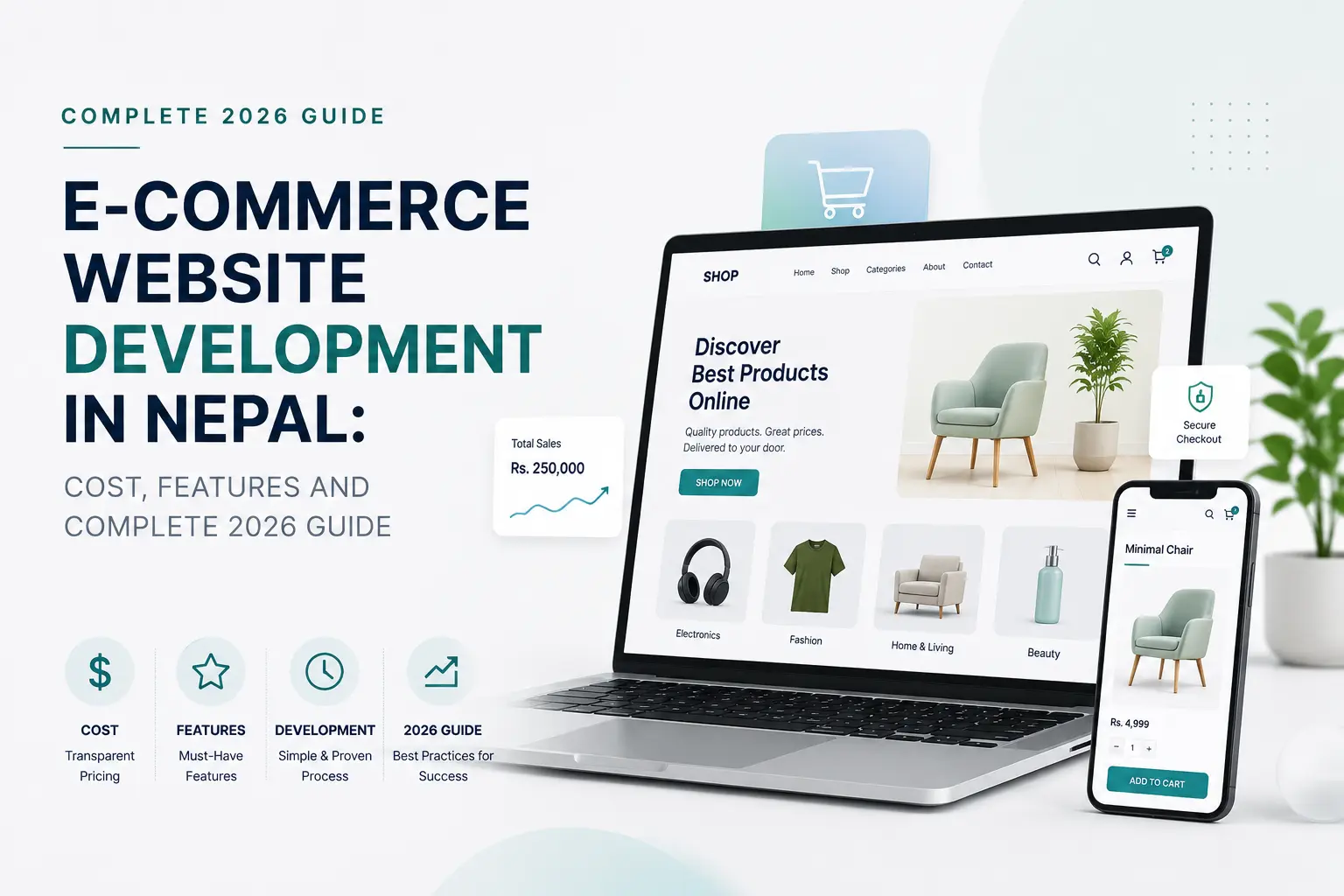
An e-commerce website should do more than display products. It should help customers find the right product, compare available options, understand the total purchase cost, trust the seller and complete an order without unnecessary difficulty.
E-commerce website development in Nepal combines commercial planning, product catalogue management, mobile-first design, payment integration, delivery configuration, search engine optimisation, analytics and order management within one connected online sales system.
Businesses considering an online store usually want to understand the likely cost, development timeline, suitable platform, payment options and features required to support sales. These decisions should reflect the products, customers, internal processes and future growth plan of the business rather than the lowest quoted development price.
Gripas Marketing manages e-commerce strategy, customer journeys, SEO, content, paid advertising, analytics and customer acquisition. Technical website development is delivered through Gripas Tech, the technology and software development brand within the same business entity. This connected structure brings marketing, platform engineering, integrations and ongoing optimisation into one delivery model.
What Is E-Commerce Website Development in Nepal?
E-commerce website development is the process of creating an online system through which a business can present products, accept orders, process payments, manage inventory and coordinate delivery.
A basic online store may include product categories, product pages, a shopping cart, checkout and cash-on-delivery functionality. A professional store may also require digital payments, product filtering, automated notifications, inventory controls, customer accounts, analytics, technical SEO, CRM integration and connections with existing business software.
The correct solution depends on the number and type of products, business model, payment requirements, fulfilment process, target market, internal team and expected growth. A business selling a limited catalogue locally has different requirements from a wholesaler with customer-specific pricing or a retailer operating across stores, social channels and an online marketplace.
Key Takeaways
- E-commerce development connects product discovery, checkout, payment, inventory, order management and fulfilment.
- A basic online store may begin from approximately NPR 60,000, while advanced or custom platforms require a larger investment.
- WooCommerce suits many small and growing businesses that need flexibility, content control and WordPress integration.
- Custom development is more suitable for marketplaces, B2B commerce, ERP connections and specialised operational workflows.
- Mobile-first design matters because many customers discover and evaluate products through mobile search and social platforms.
- Payment and delivery options should reflect customer preferences, merchant eligibility and the operating model.
- Product pages should clearly explain price, availability, specifications, delivery, returns and reasons to trust the seller.
- SEO, analytics and conversion tracking should be implemented during development, not treated as late additions.
- Inventory, fulfilment and customer-support responsibilities should be defined before launch.
- Gripas Marketing manages growth strategy and customer acquisition, while Gripas Tech delivers the technical platform.
How Much Does an E-Commerce Website Cost in Nepal?
The cost of an e-commerce website in Nepal depends on the platform, design complexity, product catalogue, payment and delivery configuration, integrations and level of custom functionality.
A small online store with standard categories and checkout usually requires a lower investment than a platform with multiple user roles, customer-specific pricing, several warehouses, external software integrations or customised purchasing workflows.
Basic E-Commerce Website
A basic WooCommerce store may include responsive page templates, product categories, product pages, cart, checkout, cash on delivery, policy pages, basic SEO configuration and administrator training.
Estimated investment: NPR 60,000 to NPR 150,000+
Professional E-Commerce Website
A professional store may include a customised design, advanced filters, digital payments, delivery rules, transactional notifications, analytics, technical SEO, security and speed optimisation.
Estimated investment: NPR 150,000 to NPR 400,000+
Custom E-Commerce Platform
Custom platforms may include marketplaces, B2B pricing, subscriptions, reseller portals, multiple warehouses, ERP integration and custom approval systems. These solutions can be engineered by the Gripas Tech custom software development team.
Estimated investment: NPR 400,000+
These ranges are general planning estimates, not fixed quotations. Final pricing should follow a review of the catalogue, design, integrations, content readiness, business rules, security requirements and post-launch support.
Additional E-Commerce Website Expenses
- Domain registration and renewal
- Hosting and server resources
- Premium themes, plugins or applications
- Payment-provider setup and transaction charges
- Security monitoring and backup services
- Product photography and image preparation
- Catalogue organisation and product uploading
- Product descriptions and website copywriting
- Search engine optimisation
- Advertising and creative production
- Technical maintenance and support
- Future integrations and custom development
A low-cost website can become expensive when it loads slowly, creates checkout problems, needs repeated repairs or cannot support the business as the catalogue and order volume grow.
Which E-Commerce Platform Is Best for Businesses in Nepal?
The best platform depends on catalogue size, available budget, internal capability, payment compatibility, integration needs and required control.
WooCommerce
WooCommerce suits many small and medium businesses that want a flexible WordPress-based store with control over content, SEO, design and functionality. The business remains responsible for hosting, updates, security and extension compatibility.
Shopify
Shopify offers a managed subscription environment and may suit brands prioritising operational simplicity or international selling. Local payment compatibility, recurring costs, application fees and required customisation should be checked before selection.
Custom Development
Custom development is appropriate when standard platforms cannot support required inventory rules, pricing, user roles, integrations or approval workflows. It offers greater control but normally requires a larger budget and ongoing technical ownership.
Headless E-Commerce
A headless system separates the customer-facing storefront from the commerce backend. It can provide flexibility and strong performance but introduces more technical complexity, integration work and maintenance.
Questions to Answer Before Selecting a Platform
- How many products and variations will be available at launch?
- How quickly is the catalogue expected to expand?
- Which payment methods must be supported?
- How will stock availability be updated?
- Will the business operate from one or several locations?
- Is accounting, CRM, POS or ERP integration required?
- Will retail, wholesale and reseller customers receive different prices?
- Who will manage products, orders, returns and customer communication?
- Does the business plan to sell outside Nepal?
- What reporting is required for management decisions?
Which Features Should an E-Commerce Website Include?
A useful e-commerce website makes discovery, comparison, purchasing and order management straightforward for customers and administrators.
Mobile-First Design
Images, prices, menus, filters, calls to action and checkout fields should remain clear and easy to use on smaller screens.
Catalogue Structure
Products should be organised around useful categories, brands, product types, use cases and attributes rather than internal naming alone.
Search and Filtering
Customers should be able to search and filter by attributes that influence purchase decisions, such as price, brand, size, colour and availability.
Product Variations
The store should correctly manage sizes, colours, models, capacities, images, prices, SKUs and stock levels.
Cart and Checkout
The checkout should request only the information necessary to process payment, contact the buyer and deliver the order.
Payment Integration
The store may support cash on delivery, bank transfer, cards, approved wallets, QR payments or other suitable methods.
Delivery Configuration
Delivery areas, charges, estimated periods, free-delivery thresholds and exclusions should be clearly configured.
Inventory Management
Administrators should be able to update stock, manage variations, review availability and receive low-stock alerts.
Order Management
Teams should be able to review orders, confirm payment, update status and coordinate fulfilment.
Customer Accounts
Accounts may allow customers to review orders, manage addresses, save products and access relevant support information.
Analytics and Tracking
Tracking should measure product views, cart activity, checkout initiation, purchases, revenue and channel performance.
Technical SEO
SEO foundations include crawlable categories, metadata, canonicals, breadcrumbs, sitemaps, structured data and performance optimisation.
What Should an E-Commerce Product Page Include?
A product page should resolve the questions that could prevent a suitable customer from purchasing.
- A clear product name
- Current price and genuine sale price where applicable
- Accurate availability
- High-quality images
- Sizes, colours or models
- An original description
- Important specifications and dimensions
- Benefits and suitable use cases
- Delivery areas, charges and expected timing
- Available payment methods
- Return, exchange and refund conditions
- Warranty information where relevant
- Genuine reviews
- Frequently asked product questions
- A clear add-to-cart or purchase button
Product descriptions should not simply repeat generic supplier descriptions. Original information can answer customer concerns, explain differences between options and give search engines useful page-specific context.
Traffic cannot reliably produce revenue when the product page leaves the customer uncertain about price, quality, availability, delivery or returns.
How Does the E-Commerce Website Development Process Work?
A structured process reduces delays, exposes missing requirements early and makes the completed store easier to operate.
The technical development is delivered through Gripas Tech’s retail and e-commerce development capabilities. Gripas Marketing defines the commercial, content, SEO and acquisition requirements, while the development team translates those requirements into a working platform.
- Business discovery: Review products, customers, competitors, sales model, payment requirements and fulfilment.
- Requirements planning: Define the platform, catalogue structure, integrations, roles and future needs.
- Website architecture: Plan categories, products, information pages, checkout and account areas.
- User experience: Design mobile and desktop journeys from discovery to purchase.
- Visual design: Apply brand identity, typography, colours and product presentation.
- Platform development: Configure or build the catalogue, cart, checkout and administration features.
- Integration: Connect approved payment, delivery, CRM, inventory or operational systems.
- Product setup: Upload names, prices, images, descriptions, variations, specifications and stock.
- SEO implementation: Configure metadata, structured data, canonicals, breadcrumbs and indexation.
- Analytics setup: Track product views, add-to-cart actions, checkout events, purchases and revenue.
- Testing: Test usability, payments, shipping, discounts, emails, administration and realistic orders.
- Launch: Publish the store, verify essential functions and monitor early activity.
- Improvement: Use customer behaviour, support questions and sales data to refine the experience.
How Should Payments, Inventory and Delivery Be Managed?
Payments, inventory and delivery should be designed as connected operational processes, not isolated website features.
Payment Options
Depending on the business, customers may be offered cash on delivery, approved digital wallets, QR-based payments, mobile banking, bank transfer or card payment. Merchant eligibility, technical compatibility, verification requirements and current provider charges should be confirmed before implementation.
A browser confirmation message alone should not be treated as proof of payment. The store should verify transaction status through the payment provider’s approved technical process before moving an order into fulfilment.
Inventory Management
Inventory becomes more difficult when the same products are sold through a physical shop, social media, marketplaces and an independent website. The business should determine which system is the reliable source of stock data and how updates will move between channels.
Delivery and Fulfilment
Customers should know where delivery is available, how much it costs and when an order is expected. Unexpected charges at the end of checkout can create avoidable abandonment.
- Define delivery locations and exclusions.
- Configure area-based charges.
- Explain estimated delivery periods.
- Define same-day or next-day conditions.
- Plan failed-delivery procedures.
- Explain returns and exchanges.
- Provide order-status communication.
How Can an E-Commerce Website Generate More Sales?
Development creates the store, but growth depends on qualified traffic, persuasive product information, dependable operations, accurate tracking and continuous conversion improvement.
E-Commerce SEO
Optimise categories, product pages, internal links, images, metadata, structured data, technical performance and buying guides.
Google Advertising
Reach people searching for relevant products and evaluate campaigns using sales, revenue and acquisition cost.
Facebook and Instagram Advertising
Use product discovery, catalogue campaigns, retargeting and promotional advertising to attract suitable buyers.
Social Media Content
Publish useful demonstrations, comparisons, new arrivals, buying guidance and genuine customer experiences.
Email and CRM Automation
Connect order updates, abandoned-cart communication, review requests, reorder reminders and customer segments.
Conversion Optimisation
Review page engagement, checkout exits, delivery concerns and repeated questions to improve conversion performance.
Metrics Worth Monitoring
- Product views
- Search and filter usage
- Add-to-cart rate
- Checkout initiation
- Checkout completion
- Conversion rate
- Average order value
- Customer acquisition cost
- Advertising return
- Cart abandonment
- Returning customer rate
- Revenue by channel
How Should You Choose an E-Commerce Development Company in Nepal?
Choose a team that understands customer experience, technology, business operations, SEO, tracking and post-launch growth.
- The team reviews the business model before recommending a platform.
- The proposal clearly defines included and excluded features.
- The website is designed for mobile customers.
- Payment integration follows the provider’s approved process.
- Administrators can manage products, stock, prices and orders.
- Delivery workflows are planned before launch.
- Technical SEO is included during development.
- Analytics and commerce events are tested.
- Security, backups and updates are documented.
- The business receives administrator training.
- Maintenance responsibilities are clearly assigned.
- The team can support marketing and optimisation after launch.
Why Choose Gripas for E-Commerce Website Development in Nepal?
Gripas combines commercial strategy, technical development, SEO, advertising, analytics and ongoing optimisation within the same business entity.
Gripas Marketing manages business discovery, customer-journey planning, product positioning, SEO, content, paid campaigns, analytics, CRM and conversion improvement.
The website and its underlying systems are delivered through Gripas Tech. Its role may include architecture, frontend and backend development, WooCommerce configuration, custom functionality, payment integration, inventory workflows, testing, deployment, maintenance and future technical enhancements.
This structure reduces the need to coordinate unrelated development and marketing providers. The online store, catalogue, operational workflows, technical infrastructure and acquisition channels can be planned as parts of one commercial system.
Gripas Marketing
- E-commerce strategy
- Customer-journey planning
- Product and category content
- E-commerce SEO
- Google and Meta advertising
- Analytics and conversion measurement
- CRM and customer follow-up
- Conversion optimisation
Gripas Tech
- Platform architecture
- WooCommerce development
- Custom platform development
- Frontend and backend engineering
- Payment integration
- Inventory and order integrations
- Custom business workflows
- Testing, deployment and maintenance
Gripas Marketing plans how the store will attract and convert customers. Gripas Tech builds and maintains the technology supporting the purchasing and operational journey.
Build an E-Commerce Website Designed for Growth
Gripas can review your products, customers, payment requirements, delivery model, technical needs and growth objectives before preparing a custom proposal. Strategy and marketing are managed through Gripas Marketing, while technical delivery is completed through Gripas Tech.
Frequently Asked Questions
How much does an e-commerce website cost in Nepal?
A basic store may begin from approximately NPR 60,000, while professional and custom platforms may require NPR 150,000 to NPR 400,000 or more. Final pricing depends on platform, catalogue size, design, integrations, delivery rules and custom features.
How long does it take to develop an e-commerce website?
A standard store may require approximately four to eight weeks, while an advanced custom platform can require several months. Product data, integrations, approvals, testing and content readiness affect the schedule.
Can eSewa, Khalti and Fonepay be integrated?
Integration may be possible depending on the platform and merchant solutions currently available from each provider. Eligibility, documentation, charges and technical requirements should be confirmed directly with the relevant provider.
Is WooCommerce or Shopify better for a Nepali business?
WooCommerce offers WordPress integration, content control and extensive customisation, while Shopify provides a managed subscription environment. The right option depends on payment compatibility, budget, catalogue needs, technical resources and international plans.
Can an e-commerce website rank on Google?
An online store can earn search visibility when it has useful category pages, original product information, a crawlable structure, technical SEO, structured data and suitable performance. SEO should be considered during architecture and development.
Should a small business sell only through social media?
Social platforms can support discovery and communication, but an independent website gives the business more control over catalogue presentation, search visibility, analytics and ordering. Both can work together within the same customer journey.
Who develops websites for Gripas Marketing projects?
Technical e-commerce development is delivered through Gripas Tech, the technology and software development brand within the same business entity. Gripas Marketing manages strategy and customer acquisition, while Gripas Tech manages platform development, integrations, testing and technical maintenance.
Does Gripas provide e-commerce maintenance?
Maintenance can be included according to the approved proposal. It may cover backups, security checks, platform updates, performance work, functionality support and technical fixes.
Related Gripas Resources
Editorial and Implementation Disclaimer
The prices and timelines in this guide are general planning estimates. Final cost, scope and timing depend on the selected platform, integrations, product catalogue, data readiness, design requirements and approved proposal.
Payment-provider availability, merchant eligibility, fees and technical requirements may change. Businesses should verify current details with the relevant provider and obtain appropriate legal, accounting or regulatory guidance before launching an e-commerce operation.