
How voice search in Nepal will evolve by 2026 and what Nepali businesses must do to turn it into a powerful channel for local visibility, customer acquisition, and long-term growth.
Voice search is rapidly transforming how people search for information online. Instead of typing queries, users now speak naturally to voice assistants such as Google Assistant, Siri, and Alexa to find answers, directions, and services. In Nepal, the growing use of smartphones, improved internet access, and increased comfort with digital assistants are accelerating this shift. As we approach 2026, voice search is expected to play a much larger role in how consumers discover businesses.
For Nepali businesses, especially those operating in major cities, like the Kathmandu Valley, voice search presents both significant opportunities and notable challenges. Understanding how voice search works and preparing early will help businesses remain visible, competitive, and relevant in the years ahead.
Key Insights
- Voice search is growing quickly in Nepal as mobile internet access expands, making hands-free, on-the-go searching more natural for users, especially in urban areas like Kathmandu.
- Most voice queries carry strong local intent, so businesses with accurate Google Business Profiles and well-executed local SEO are far more likely to be recommended by voice assistants.
- Content that uses clear, conversational language, answers specific questions directly, and is supported by FAQs, long-tail keywords, and fast mobile performance is far more likely to appear as the single spoken result.
- Nepali businesses still struggle with low awareness of voice search, mixed Nepali-English usage, limited structured data, and the difficulty of measuring voice-specific performance in standard analytics tools.
- By 2026, more personalised, AI-driven voice search integrated with apps, smart devices, and e-commerce will reward early adopters who invest in technical SEO, schema markup, and strong local optimisation today.
Table of Contents
What Is Voice Search and How Does It Work?
Voice search enables users to conduct searches by speaking into a device, rather than typing. Voice assistants utilise artificial intelligence, machine learning, and natural language processing to comprehend spoken queries and provide accurate responses. These queries are typically longer, more conversational, and often framed as questions.
In Nepal, most voice searches are performed on smartphones using Google Assistant. Users commonly ask for directions, business information, product recommendations, or quick answers. Unlike traditional search results that show multiple links, voice assistants usually provide a single spoken answer, making competition for visibility much higher.
Why Voice Search Matters for Nepali Businesses in 2026
Voice search matters because it changes how consumers interact with search engines. As hands-free and mobile-first behaviour grows, users expect faster and more direct answers. In Nepal, where mobile usage dominates, voice search is becoming a convenient option for users while commuting, working, or multitasking.
By 2026, businesses that fail to optimise for voice search risk losing visibility, particularly in local searches. Service-based businesses such as restaurants, clinics, hotels, and professional services will be most affected, as voice queries often include phrases like near me, open now, or best service nearby.
Key Opportunities of Voice Search for Businesses in Nepal
Voice search creates powerful growth opportunities for Nepali businesses that are ready to adapt early and serve customers who search by speaking instead of typing. It is especially valuable for local brands in the Kathmandu Valley that want more visibility, better quality traffic, and higher conversions.
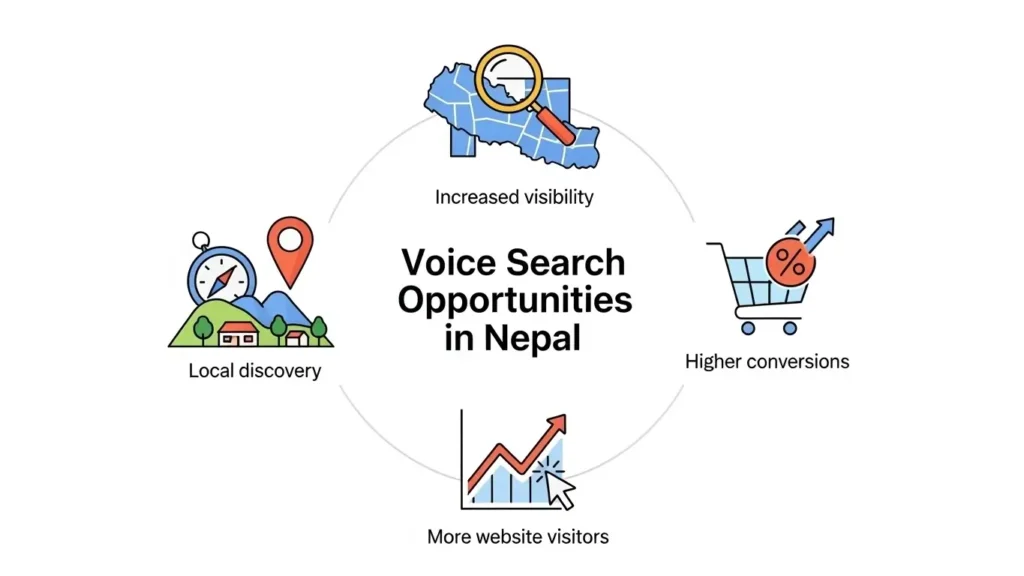
- Increased visibility through featured snippets or position zero, where voice assistants often read a single top answer aloud.
- Stronger local discovery for Kathmandu and other cities, as Google prioritises accurate, well-optimised business listings in near me and nearby searches.
- Competitive advantage for businesses with clear contact details, consistent NAP data, and strong local SEO over less-optimised competitors.
- More intent-driven traffic from users who ask specific questions and are ready to act, such as booking, visiting, or calling.
- Higher conversion potential for brands that provide direct, relevant, and helpful answers tailored to common voice queries.
Voice Search and Local SEO in Nepal
Local SEO is closely connected to voice search. Many voice queries have local intent, such as finding a restaurant, shop, or service provider nearby. For Nepali businesses, optimising Google Business Profiles is essential to appear in voice search results.
Accurate business information, including address, phone number, operating hours, and customer reviews, improves visibility. Using conversational, location-based keywords in website content also helps search engines match voice queries with relevant businesses.
For companies in Kathmandu Valley, local optimisation ensures that voice assistants can easily recommend their services to nearby users searching in real time.
Content Optimisation for Voice Search
Content plays a critical role in voice search optimisation. Voice queries are typically phrased as full questions, so content should be written in a natural, conversational tone. Clear and direct answers increase the chances of being selected as the voice response.
Structuring content with headings, bullet points, and frequently asked questions helps search engines understand context. Long-tail keywords and question-based phrases should be incorporated naturally into blog posts, service pages, and landing pages.
Mobile optimisation and fast page loading are equally important. Since most voice searches in Nepal are conducted on smartphones, slow or poorly optimised websites reduce visibility and user satisfaction.
Challenges of Voice Search Adoption in Nepal
Despite its potential, voice search adoption in Nepal comes with challenges. Many businesses are still unaware of voice search or do not understand how it impacts search behaviour. This lack of awareness delays optimisation efforts.
Language complexity is another challenge. Nepali users often mix Nepali and English when speaking, and pronunciation variations can affect accuracy. Limited availability of high-quality structured data on websites further complicates optimisation.
Measuring voice search performance is also difficult. Unlike traditional search, voice search data is not always clearly segmented in analytics tools, making it harder for businesses to track impact and ROI.
How Nepali Businesses Can Prepare for Voice Search
Preparation begins with strengthening technical SEO foundations. Websites should be mobile-friendly, fast-loading, and secure. Implementing schema markup and structured data helps search engines understand content more effectively.
Businesses should focus on answering common customer questions clearly and concisely. Updating content regularly and ensuring accuracy builds trust and authority. Local optimisation, including updated Google Business Profiles and consistent listings, is essential.
By preparing early, Nepali businesses can position themselves as reliable answers in voice search results rather than competing later in a more crowded space.
Voice Search Trends to Watch in 2026
By 2026, voice search will become more personalised and context-aware. AI-driven assistants will deliver more accurate responses based on user behaviour, preferences, and location. Multilingual voice search will also expand, allowing users to switch between languages seamlessly.
Integration with mobile apps, smart devices, and e-commerce platforms will increase. Voice-driven actions such as booking services or placing orders will become more common, creating new opportunities for businesses that adapt quickly.
Common Voice Search Mistakes Businesses Should Avoid
Many Nepali businesses miss out on voice search traffic because they treat it like normal SEO and ignore how people actually speak and search on mobile. Avoiding a few common mistakes can significantly improve visibility, especially for local searches in Kathmandu and across Nepal.
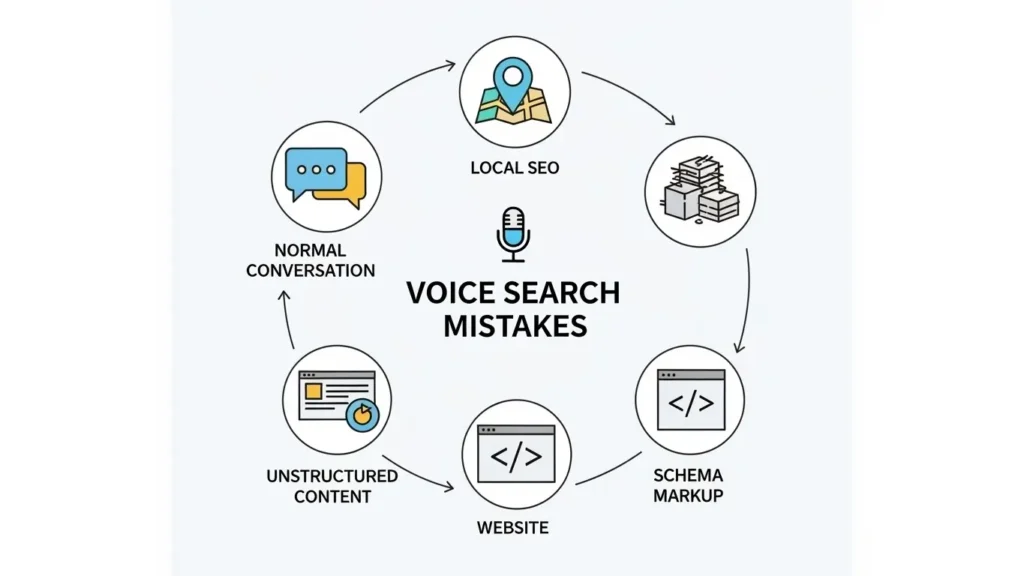
- Ignoring conversational, question-style keywords and focusing only on short, typed phrases.
- Neglecting local SEO basics, including complete and accurate business listings and location terms.
- Publishing content that does not give clear, direct answers to common customer questions.
- Failing to optimise websites for mobile devices, speed, and user experience, which weakens voice rankings.
- Overlooking structured data and schema markup that help search engines understand and surface your content in voice results.
Conclusion
Voice search is reshaping how consumers find information, and its impact in Nepal is expected to continue growing through 2026 and beyond. While challenges such as language complexity and measurement exist, the opportunities for visibility, local discovery, and conversions are significant.
Businesses that adapt early, optimise content, and strengthen local SEO will gain a lasting advantage. With expert guidance and strategic preparation, Nepali businesses can turn voice search into a powerful channel for growth and long-term digital success.
Prepare Your Business for Voice Search in 2026
At Gripas Marketing, we help Nepali businesses prepare for emerging search trends, including voice search optimisation. Our team focuses on technical SEO, content strategy, and local optimisation to ensure brands remain visible and competitive.
If you want your business to be the answer users hear in 2026, we are here to help. Contact Gripas Marketing today for a free consultation and take proactive steps towards voice search readiness.
Frequently Asked Questions (FAQs)
What is voice search, and how is it used in Nepal?
Voice search lets users speak queries to assistants like Google Assistant or Siri instead of typing. In Nepal, people mostly use it on smartphones for directions, local services, and quick answers.
Why is voice search important for Nepali businesses in 2026?
Voice search is changing how customers discover nearby businesses, especially on mobile. Companies that optimise early will appear more often when users ask for services near them.
How does voice search affect local SEO in Kathmandu Valley?
Voice search relies heavily on accurate location data, reviews, and relevance for near me queries. Strong local SEO helps Kathmandu businesses show up first when users ask for nearby options.
Do I need a Google Business Profile for voice search?
Yes, a well-optimised Google Business Profile is critical because assistants pull data from it for local recommendations. Correct address, phone number, hours, and categories improve your chances of being suggested.
What type of content works best for voice search?
Content that answers specific questions in simple, natural language works best. Short, direct responses in FAQs or headings are more likely to be read aloud by voice assistants.
How can I optimise my website for voice search on mobile?
Ensure your site is fast, mobile-friendly, and secure, with clear navigation. Combine this with conversational keywords and structured data to help search engines understand your content.
Does mixing Nepali and English in queries affect voice search?
Yes, mixed-language speech and varied pronunciation can reduce accuracy, but models are improving. Creating content that reflects real user phrases can still help you match those queries.
How can I measure the impact of voice search on my business?
You can track near me and question-based keywords, local impressions, and calls from Google listings. While exact voice data is limited, trends in local traffic and enquiries show its impact.
What are the most common mistakes businesses make with voice search?
Many ignore conversational keywords, neglect local SEO, or publish content without clear answers. Others overlook mobile speed, which harms both rankings and user experience.
How can Gripas Marketing help my business with voice search?
Gripas Marketing in Kathmandu focuses on technical SEO, content strategy, and local optimisation for Nepali brands. The team helps you become the answer users hear when they search by voice in 2026 and beyond.