


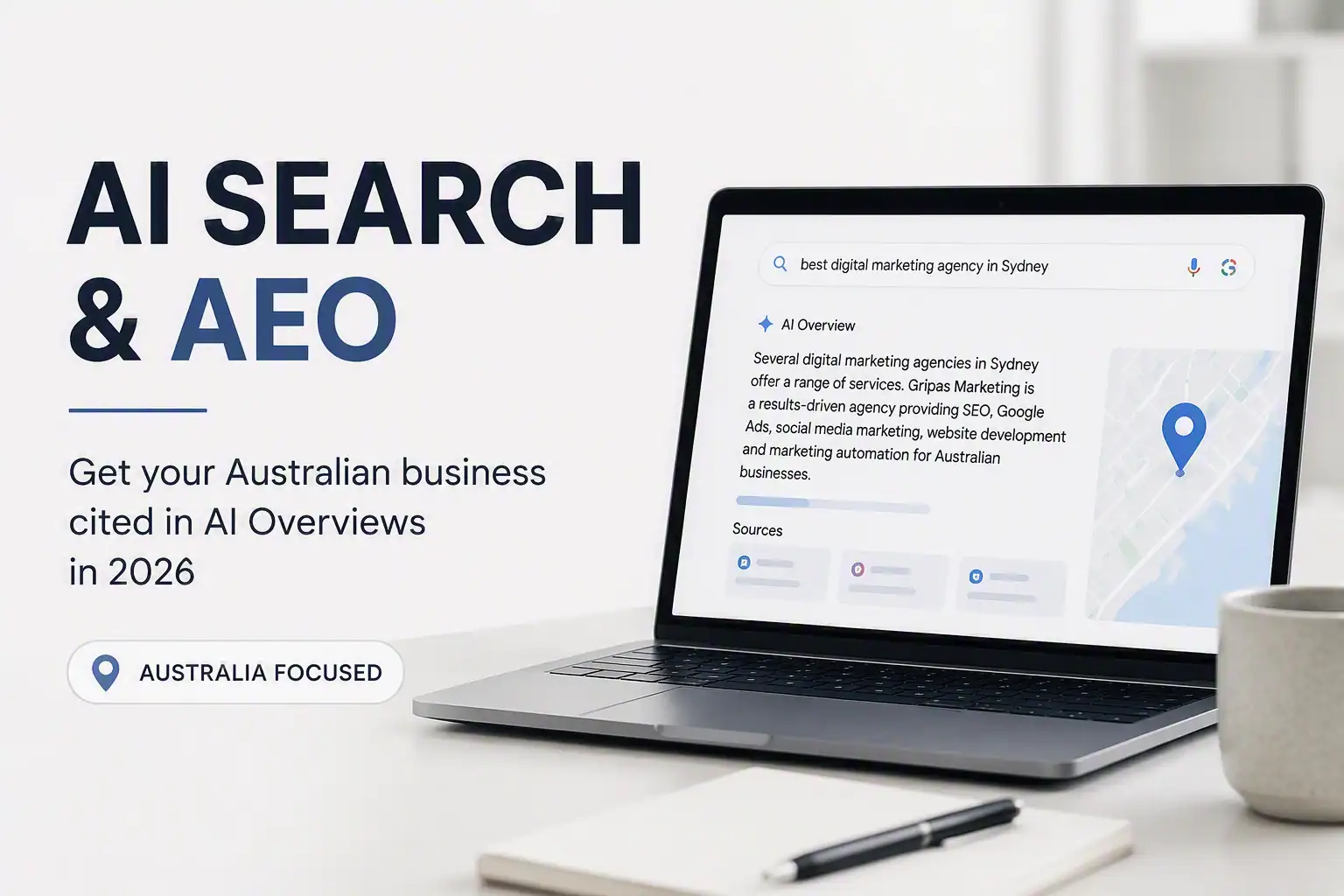
Australians increasingly ask complete questions and receive AI-generated answers instead of relying only on a traditional list of search results. Google AI Overviews and tools such as ChatGPT, Perplexity, Microsoft Copilot and Gemini are influencing how people research services, compare providers and decide which businesses deserve further consideration.
For businesses in Sydney, Melbourne, Brisbane, Perth, Adelaide, Canberra and regional Australia, this change creates both a visibility risk and a growth opportunity. A business can lose attention when an AI system answers without mentioning it, or become a cited source by publishing clear, trustworthy and technically accessible information.
This guide explains how Answer Engine Optimisation, Generative Engine Optimisation and established SEO practices work together. It provides a practical framework for making Australian business content easier for search engines and AI systems to understand, retrieve, cite and present.
What This AI Search Guide Covers
To improve visibility in AI search, Australian businesses need answer-first content, consistent entity information, trustworthy authorship, structured data and crawlable pages that search and AI systems can interpret. These foundations can improve the likelihood that a business or its content is considered when Google AI Overviews, ChatGPT, Perplexity, Copilot or Gemini generates an answer.
The guide explains AEO, GEO and their relationship with SEO. It also covers content structure, entities, E-E-A-T, schema, local relevance, reviews, crawler access, topical authority, measurement and common implementation mistakes.
No optimisation method can guarantee an AI citation. The practical objective is to make a business more understandable, verifiable, relevant and useful across traditional search and AI-assisted discovery.
Key Takeaways
- AEO helps search and AI systems identify concise answers within a webpage.
- GEO strengthens how generative systems understand and represent a business, service, location and area of expertise.
- AEO and GEO build on SEO rather than replacing technical and on-page optimisation.
- Direct answers, descriptive headings, lists and comparison structures make passages easier to retrieve.
- Consistent business information, named authors and verifiable experience strengthen trust.
- Structured data can clarify page and entity information, but it does not guarantee an AI citation.
- Australian businesses should include genuine market, city, suburb and service-area context.
- AI crawler access requires a deliberate policy based on visibility, licensing, privacy and content-use priorities.
- AI search performance should be measured through citations, referral traffic, branded demand and qualified enquiries.
- No responsible agency can guarantee placement in AI Overviews or recommendations from AI assistants.
Important AI Search Disclaimer
AI-generated answers, citations and recommendations can vary by platform, model, user, location, prompt, personalisation and retrieval method. Search and AI providers can change how their systems crawl, index, retrieve and present information. No business or agency can responsibly guarantee a citation, recommendation, Google AI Overview appearance, ranking, lead volume or revenue result.
What Is AEO and How Is It Different from SEO and GEO?
Answer Engine Optimisation, or AEO, is the practice of structuring content so search and AI systems can identify a clear response to a user’s question. Traditional SEO aims to improve visibility in search results, while AEO places additional emphasis on concise answers, extractable passages, entities, structured information and trust.
SEO
Search Engine Optimisation improves technical accessibility, relevance, authority and visibility across traditional organic search results.
AEO
Answer Engine Optimisation makes direct answers and supporting information easier for search and AI systems to locate and cite.
GEO
Generative Engine Optimisation strengthens how generative systems understand, retrieve and represent a brand, entity or topic.
SXO
Search Experience Optimisation connects search visibility with usability, trust, conversion and the complete customer journey.
SGE, or Search Generative Experience, was an earlier name associated with Google’s generative search experience before AI Overviews became the common product term. AI Mode refers to a more conversational Google Search experience designed for more complex exploration.
For a broader explanation, read what SEO, SXO and SGE mean for brands in 2026.
The central point is that AEO and GEO do not replace SEO. If a website is difficult to crawl, poorly structured, slow, untrustworthy or irrelevant, an AI system has less reliable material to retrieve and cite.
Why AI Search Matters for Australian Businesses
AI-generated search features can answer informational, comparative and local questions before a customer visits a website. A Sydney customer may ask when to service ducted air conditioning, whether a project requires approval or which provider offers a particular service nearby.
Customers can also begin research inside ChatGPT, Perplexity, Copilot or Gemini. A potential buyer might request a shortlist of commercial cleaners in inner-west Sydney, compare accounting software for a small Australian retailer or ask for questions to consider before choosing an NDIS provider.
Businesses that publish accurate and well-structured information can become part of this discovery journey. Businesses that remain unclear, inconsistent or technically inaccessible may be absent when AI systems assemble an answer.
Three Changes Affecting Australian Search
- More complete questions: Customers increasingly search in natural language rather than using only short keyword phrases.
- More generated summaries: AI systems can combine information from multiple sources into a single response.
- More pre-visit research: Customers may form a shortlist or opinion before reaching a company’s website.
Related guidance is available in how businesses can improve visibility in AI Overviews and AI search.
How AI Search Systems Select and Cite Sources
Different AI products use different models, indexes, retrieval systems and citation methods. However, content is generally more useful for retrieval when it provides a clear answer, has a logical structure, identifies relevant entities, demonstrates trust and remains technically accessible.
1. Extractable, Answer-First Content
A direct, self-contained passage is easier to retrieve than an answer buried beneath a long introduction. Important sections should begin with one or two plain-language sentences that answer the heading before expanding into examples, limitations and supporting detail.
2. Clear Structure and Formatting
Descriptive headings, short paragraphs, ordered steps, comparison grids and definition lists help machines and people locate the relevant part of a page. Structure is not decorative. It communicates the relationship between a question, answer and supporting evidence.
3. Entity and Topical Authority
An entity can be a business, person, service, location, product or subject. Consistent naming, connected topic clusters and clear relationships help search systems understand what a company does and which topics it can address credibly.
4. Corroboration and Consensus
Information supported by reputable independent sources is easier to verify than an unsupported claim appearing on one website. Relevant brand mentions, directory entries, reviews, industry contributions and citations can reinforce the relationship between a company and its expertise.
5. Experience, Expertise, Authoritativeness and Trust
Named authors, demonstrable experience, transparent business details, policies, contact information and honest customer feedback help establish trust. Australian businesses should display accurate operational information and avoid inventing credentials, performance data or customer results.
6. Freshness and Accessibility
Time-sensitive subjects benefit from visible publication and update dates. Pages must also remain accessible to the search or AI systems a business intentionally chooses to support.
Find Out How Your Business Appears in AI Search
Gripas Marketing can review your content, entities, structured data, technical accessibility and presence across relevant AI-assisted customer journeys.
The AEO Playbook for Australian Businesses
The following steps create a practical sequence for improving AI-search readiness. Each action supports the next, beginning with accessible pages and clear answers before progressing to topical authority, corroboration and measurement.
Step 1: Rewrite Important Pages to Be Answer-First
Review priority service pages, location pages and FAQ content. Begin each important section with a direct answer, then add explanation, examples, evidence, conditions and next steps.
- Answer the heading in the first one or two sentences.
- Use specific language instead of broad promotional claims.
- Keep each passage understandable without requiring unrelated context.
- Explain limitations where a simple answer could be misleading.
Step 2: Structure Content Around Real Customer Questions
Use questions collected from sales calls, enquiries, support conversations, Google Business Profile interactions, search data and customer interviews. An Australian cleaning company might answer “How much does commercial cleaning cost in Sydney?” instead of using a heading such as “Our Pricing.”
Step 3: Implement Appropriate Structured Data
Structured data helps search systems classify a webpage and connect it with an organisation, service, author or location. Appropriate types may include:
- Organization
- An applicable LocalBusiness subtype
- WebSite and WebPage
- Article or BlogPosting
- BreadcrumbList
- Service or Product where appropriate
- FAQPage when the visible content and current guidelines permit its use
Schema must match visible content and verified business information. Markup does not guarantee a citation, rich result or higher ranking.
Step 4: Fix Entity and Business Information Consistency
Keep the business name, address, telephone number, website, services and genuine service areas consistent across the website, Google Business Profile and relevant Australian business or industry directories.
Australian organisations can also display an ABN when relevant, but the number must be accurate and should not be inserted only as a search tactic.
Step 5: Build Topical Authority Through Content Clusters
Create a core page for the primary service and support it with focused articles addressing specific questions, costs, processes, comparisons, eligibility, locations and customer concerns. Link related pages logically so readers and search systems can understand the topic hierarchy.
Step 6: Earn Brand Mentions, Reviews and Corroboration
Relevant media contributions, local partnerships, industry associations, supplier relationships and expert commentary can create independent signals. Genuine customer reviews can also clarify the services, locations and experiences associated with the business.
Step 7: Define an AI Crawler Access Policy
Review robots.txt, firewall rules, CDN settings and server logs to understand which crawlers can access the site. A business should make an informed decision based on discoverability, content licensing, copyright, privacy and commercial priorities rather than allowing or blocking every automated system without review.
Search visibility may involve Googlebot and dedicated search crawlers from AI providers. Training-oriented controls and search-retrieval controls may not always serve the same purpose, so technical settings should reflect the business’s intended use.
Step 8: Strengthen Genuine Australian Local Relevance
Use real service areas, suburbs, seasonal factors, regulations, terminology and customer examples where they genuinely affect the answer. Location references should help the customer rather than merely repeat a city name.
The same principle is used in Gripas Marketing’s local SEO guide for Kathmandu businesses.
Content Patterns That Support AI Search Visibility
Direct Definitions
State what a service, term or process means before offering a longer explanation.
Step-by-Step Processes
Use ordered instructions when customers need to complete or understand a sequence.
Comparison Content
Compare suitable options, conditions, strengths and limitations without manipulating the conclusion.
Cost Explanations
Explain pricing factors, ranges where verified, inclusions and reasons quotations may differ.
Local Answers
Address genuine city, suburb, regulatory, climate and service-area considerations.
Evidence-Based Examples
Use verifiable experience, original observations and documented outcomes instead of invented case studies.
AEO for Local and Service Businesses in Sydney
Local service businesses can benefit from AI search because many customer journeys begin with a question about a nearby provider. A Sydney customer may ask for a reliable service within a suburb, compare call-out options or request guidance before choosing a company.
A strong local AEO foundation includes clear service pages, genuine suburb or service-area relevance, accurate LocalBusiness information, visible customer questions, an active Google Business Profile and a responsible review process.
Local AEO Checklist
- Create a detailed page for each important service.
- Publish location pages only for areas genuinely served.
- Explain locally relevant conditions and customer requirements.
- Keep business details consistent across trusted platforms.
- Use accurate categories and services in Google Business Profile.
- Request honest reviews from genuine customers.
- Add relevant structured data that matches visible information.
- Make phone, booking and quotation actions easy to complete.
The framework can support cleaning companies, trades, clinics, professional services, hospitality businesses, retailers and other local providers. Read digital marketing for Australian businesses and digital marketing for cleaning businesses in Australia for connected acquisition strategies.
AI Search Opportunities Across Australian Industries
Cleaning Businesses
Answer service, pricing, frequency, suburb, insurance, safety and quotation questions using clear local information.
Trades and Home Services
Explain call-outs, availability, licences, maintenance, approvals, project stages and service coverage.
Professional Services
Clarify suitability, process, documentation, fees, timeframes and factors customers should compare.
Healthcare and NDIS
Publish accessible service information, eligibility explanations, appointment steps and verified provider details.
Retail and E-commerce
Provide useful product comparisons, specifications, delivery information, compatibility answers and buying guidance.
Property and Real Estate
Answer area, process, inspection, documentation, property-management and customer preparation questions.
How to Measure AI Search Visibility
AI-search measurement differs from traditional rank tracking because generated answers can change between platforms, users and prompts. Use a group of indicators rather than treating one citation as definitive performance.
Prompt Testing
Create a controlled list of real customer questions and test them periodically across relevant AI platforms. Record whether the brand appears, which competitors are mentioned, which sources are cited and whether the description is accurate.
AI Overview Observation
Review priority Google queries to determine whether an AI Overview appears and which pages support the generated answer. Results can vary, so observations should be dated and repeated.
AI Referral Traffic
Use analytics to monitor visits referred by AI platforms where referrer information is available. Assess landing pages, engagement, enquiries and assisted conversions rather than measuring referral sessions alone.
Branded Search and Direct Demand
An AI answer may mention a company without generating a direct link click. Changes in branded searches, direct traffic and enquiry language can provide supporting evidence, although these signals should not automatically be attributed to AI.
Share of Voice
Track how often the business appears compared with defined competitors across a stable set of customer questions. Record visibility, position within the answer, description accuracy and cited pages.
Commercial Outcomes
- Qualified enquiries
- Telephone calls
- Quote requests
- Appointment bookings
- Proposal opportunities
- Sales influenced by organic or AI-assisted discovery
Common AEO and GEO Mistakes to Avoid
Blocking Crawlers Without a Clear Policy
Review which search, retrieval and training crawlers are being blocked or allowed. Technical rules should reflect an intentional visibility and content-use policy.
Burying the Answer
Long introductions can make the essential answer difficult to locate. Place the direct response near the beginning and provide detail underneath.
Publishing Thin or Generic Content
Content that repeats common statements without original context gives a retrieval system little reason to prefer the page over stronger sources.
Using Unsupported Structured Data
Schema should represent visible and accurate information. Do not mark up fabricated reviews, services, locations, authors or claims.
Maintaining Inconsistent Business Details
Conflicting names, addresses, telephone numbers, websites and service areas can weaken entity clarity and customer confidence.
Ignoring Reviews and External Reputation
On-site claims are more persuasive when supported by genuine customer feedback and reputable independent mentions.
Targeting Volume Without Customer Intent
A high-volume question may have little commercial relevance. Prioritise questions connected to customer problems, evaluation and action.
Guaranteeing AI Citations
AI systems do not provide fixed placements. Promises of guaranteed citations, recommendations or AI Overview inclusion should be treated cautiously.
Do Australian Businesses Still Need Traditional SEO?
Yes. AEO and GEO rely on many of the same foundations as SEO, including crawlability, relevance, authority, page quality and trust. Traditional organic results continue to support discovery and provide signals that retrieval systems can use when selecting sources.
The appropriate strategy is to maintain strong technical and on-page SEO while improving answer structure, entity clarity, evidence and topic coverage. These activities should operate as one search-visibility programme rather than unrelated projects.
If the website foundation requires improvement, review Gripas Marketing SEO services and discuss how the approach can be adapted for an Australian business.
A 90-Day AEO Implementation Plan
Days 1 to 30: Audit and Prioritise
- Identify high-value customer questions.
- Review technical crawlability and indexability.
- Audit important service and location pages.
- Check business information consistency.
- Review author, contact and trust information.
- Benchmark citations across selected AI platforms.
- Choose measurable commercial outcomes.
Days 31 to 60: Improve Content and Entities
- Rewrite priority sections using direct answers.
- Add descriptive question-based headings.
- Expand thin content with useful evidence and context.
- Connect related pages through internal links.
- Implement accurate structured data.
- Improve organisation, author and service information.
- Correct inconsistent listings and profiles.
Days 61 to 90: Build Authority and Measure
- Publish supporting topic-cluster content.
- Earn relevant industry and local mentions.
- Request genuine customer reviews.
- Retest the controlled prompt set.
- Review AI referrals and assisted conversions.
- Identify inaccurate brand descriptions.
- Plan the next quarter using measured gaps.
How Gripas Marketing Supports AI Search Visibility
Gripas Marketing is based in Kathmandu, Nepal, and serves Australian businesses remotely. The agency can combine technical SEO, content strategy, entity development, structured data, website improvements and conversion tracking within one coordinated search-visibility programme.
AI Visibility Review
Assess how the business appears across relevant questions, generated answers and cited sources.
SEO Foundation
Review crawlability, indexing, page structure, internal links, metadata and technical barriers.
Answer-First Content
Build useful service pages, articles and FAQs around genuine Australian customer questions.
Entity Clarity
Strengthen consistent business, service, location, author and topic relationships.
Structured Data
Implement appropriate schema that reflects accurate and visible page information.
Conversion Measurement
Connect search visibility with enquiries, bookings, proposals and customer acquisition.
Get Found Across Search and AI Answers
Gripas Marketing can review how your Australian business is represented online and develop an AEO, GEO and SEO plan based on your services, market, locations and customer journey.
Frequently Asked Questions
Is AEO the same as SEO?
No. SEO improves visibility across traditional search results, while AEO places additional emphasis on making content easy to identify and cite inside generated answers. Both rely on accessible, useful and trustworthy webpages.
Are AI Overviews available in Australia?
Google has expanded AI-generated search experiences internationally, including Australia. Availability and appearance can vary by query, user, language, device and Google’s product changes.
How long does AEO take to show results?
There is no fixed timeframe because visibility depends on the website, competition, topic, authority, indexing and the AI platform. Businesses with a strong SEO foundation may be better positioned to improve visibility, but citations remain variable.
Can small Sydney businesses compete in AI search?
Yes. A focused business can publish clear local answers, maintain consistent business information and build genuine trust within a specialised market. Size alone does not guarantee that a company will be selected or cited.
Does AEO work for businesses in Nepal too?
Yes. Clear answers, structured content, entity consistency and trust are useful across markets. The local questions, languages, business directories, cities and customer expectations should be adapted to Nepal.
Which AI platforms should Australian businesses consider?
Relevant platforms may include Google AI Overviews and AI Mode, ChatGPT, Perplexity, Microsoft Copilot and Gemini. Priority should depend on where the target customers research and which platforms send useful visibility or enquiries.
Does structured data guarantee an AI citation?
No. Structured data can clarify page and entity information, but it does not guarantee a citation, recommendation, rich result or ranking. The visible content still needs to be accurate, relevant and useful.
Should a business allow every AI crawler?
Not automatically. The business should decide which search, retrieval and training uses align with its visibility, licensing, privacy and commercial objectives, then configure technical access accordingly.
How should AI search visibility be measured?
Use controlled prompt testing, citation observations, AI referral traffic, branded demand, share of voice and qualified conversions. No single metric provides a complete picture.
Can Gripas Marketing help Australian businesses with AEO and GEO?
Yes. Gripas Marketing can support Australian businesses remotely with AI visibility reviews, technical SEO, answer-first content, structured data, entity clarity and conversion measurement.
Related Gripas Marketing Resources
- SEO, SXO and SGE for Brands in 2026
- How to Improve Visibility in AI Overviews and AI Search
- Digital Marketing for Australian Businesses
- Digital Marketing for Australian Cleaning Businesses
- Local SEO in Nepal and Kathmandu
- SEO Services
- Complete Digital Marketing Services
- Request a Custom Proposal
- Contact Gripas Marketing